
Immersive History · September 3, 2026
Every homeschool parent and every history teacher has had the same experience. You read the chapter. You discuss the chapter. Two weeks later you ask what the Stamp Act was, and you get a shrug.
It isn’t a discipline problem, and it usually isn’t a curriculum problem either. It’s a memory problem — and memory research has a fair amount to say about why some history sticks and most of it doesn’t.
This post is the honest version of that argument, including the parts that don’t flatter immersive learning.
Two kinds of memory, and why history usually lands in the wrong one
Cognitive psychologists have long drawn a distinction between two kinds of long-term memory:
- Semantic memory — facts stripped of context. The Declaration was adopted in 1776.
- Episodic memory — memory for events you personally experienced, with a time, a place, and a point of view. The afternoon we got lost in Philadelphia and ended up on Chestnut Street.
Most history instruction is aimed squarely at semantic memory. We hand children propositions and ask them to hold onto them. But episodic memories are, for most people, dramatically more durable and more easily retrieved — you can probably describe a family trip from a decade ago in more detail than you can reconstruct a chapter you read last month.
The interesting question for anyone building history curriculum is whether you can get historical content to encode episodically — as something the child was present for — rather than semantically, as a list.
That’s the whole thesis behind immersive learning. Not “screens are engaging.” Something narrower: an experience gets filed differently than a fact.
Four mechanisms that actually do the work
“Immersion” is a fuzzy word, and a lot of educational technology hides behind it. Here are the specific, well-documented mechanisms that make experiential learning work — and any immersive product worth buying should be doing at least two or three of them on purpose.
1. The generation effect
Information you produce yourself is remembered better than information you’re given. This is one of the more robust findings in memory research, and it’s the reason a fill-in-the-blank does more than a highlighted sentence.
Applied to the founding era: a child who has to choose between two phrasings of a grievance, and defend the choice, encodes that grievance differently than a child who reads it.
2. The testing effect (retrieval practice)
Pulling information out of memory strengthens it more than putting it in again. Re-reading feels productive and mostly isn’t. Being asked, repeatedly and in varied contexts, “wait — why were the colonists angry about this one?” is what builds durable recall.
Well-designed interactive history is essentially continuous low-stakes retrieval practice that doesn’t feel like a quiz.
3. Dual coding
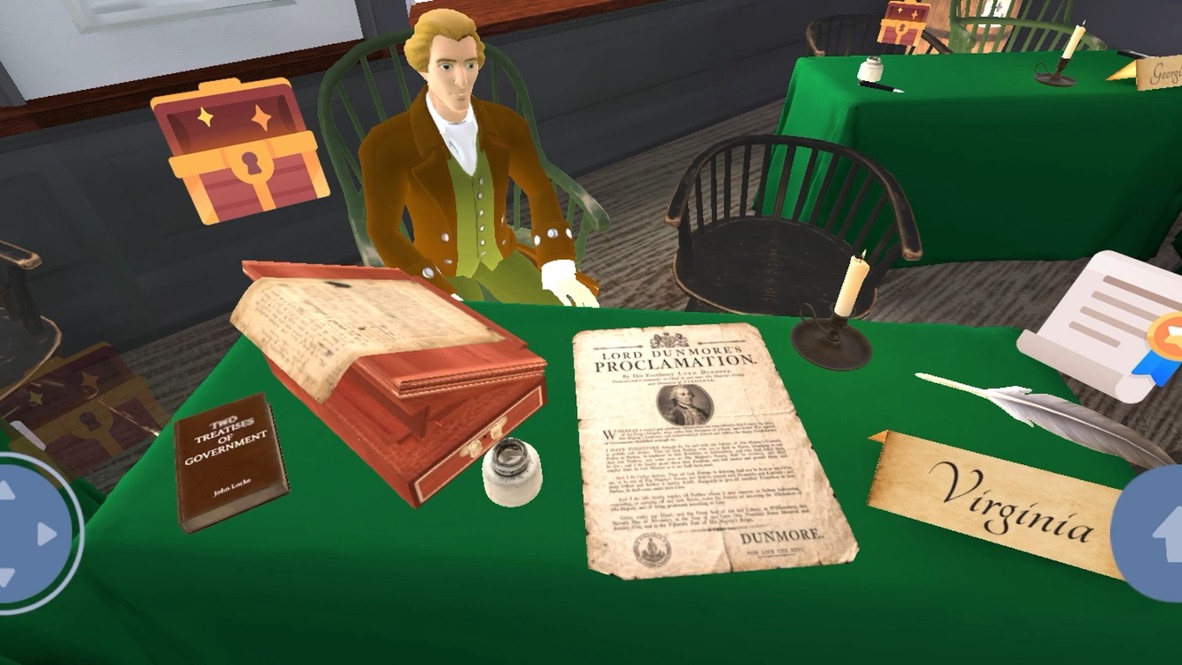
Verbal and visual information are processed through partly separate channels, and material encoded through both is recalled better than material encoded through one. A room you have walked through, with a document on a table in it, is encoded twice.
This is also, incidentally, the mechanism behind the ancient “memory palace” — spatial layout is an unusually strong retrieval scaffold for the human brain.
4. Situated and embodied cognition
Knowledge learned in a meaningful context is more transferable than knowledge learned as abstraction. A child who understands the room was hot, the vote wasn’t unanimous, and men were afraid of being hanged has a framework that new facts can attach to. A child who has the date has a date.
The narrative-identity piece
There’s a second argument, and it isn’t about recall at all.
Work on family narrative — most prominently the research associated with Marshall Duke and Robyn Fivush at Emory — found that children who knew more about their family’s history, including its hardships and setbacks, showed better outcomes on measures of resilience and self-concept. The proposed explanation is the intergenerational self: the sense that you belong to something that started before you and continues after you. Worth stating plainly: this is a correlation, drawn from a small number of studies using a self-report measure (the “Do You Know?” scale). It does not show that teaching a child history makes them resilient — families who tell these stories differ in other ways too. It’s suggestive, not proof.
That research is about families, and it would be overreaching to claim it transfers cleanly to national history. But the question it raises is a fair one, and it’s the question that made me want to build this: if knowing your family’s story helps a child locate themselves in time, what does knowing their country’s story do?
I don’t think anyone has a clean empirical answer. I think it’s a reasonable thing to bet on.
Where the case for immersive learning gets weaker
If you’re a curriculum director evaluating this category, here’s what I’d want you to press on — including about our own product.
Engagement is not learning. A child can be delighted and learn nothing. Attention is necessary and nowhere near sufficient, and “the kids loved it” is the weakest evidence in education.
Seductive details hurt. Adding vivid, entertaining but irrelevant material to a lesson can reduce learning of the core content — a well-replicated finding. The dramatic set piece has to carry the substance, not decorate it. This is the failure mode most immersive history products fall into.
Cognitive load is real. A rich environment spends working memory on navigation and novelty. If the interface is the hard part, the history isn’t getting encoded.
Experience without consolidation fades. An immersive hour with no narration, no discussion, no writing afterward is a good afternoon and a weak lesson. This is why we ship a printable lesson plan alongside the app rather than pretending the app is the whole thing.
The evidence base is genuinely mixed. Meta-analyses of immersive and game-based learning generally find positive but modest effects, with wide variation by design quality and a lot of small, short studies. Anyone quoting you a large, confident number about VR or immersive learning is selling something. So is anyone quoting you a “people remember 10% of what they read, 90% of what they do” pyramid — that figure has no valid empirical source and has been debunked repeatedly.
What this means practically
If you’re choosing or building history material, the useful test isn’t “is it immersive.” It’s:
- Does the child produce something? A choice, an argument, a signature, a narration.
- Does it require retrieval, not just exposure?
- Is the vivid part carrying the content, or decorating it?
- Is there a consolidation step after — narration, copywork, discussion, a written answer?
- Could the child tell you about it a week later without prompting? That last one is the only test that matters, and it’s free to run.
How we try to do this in 1776
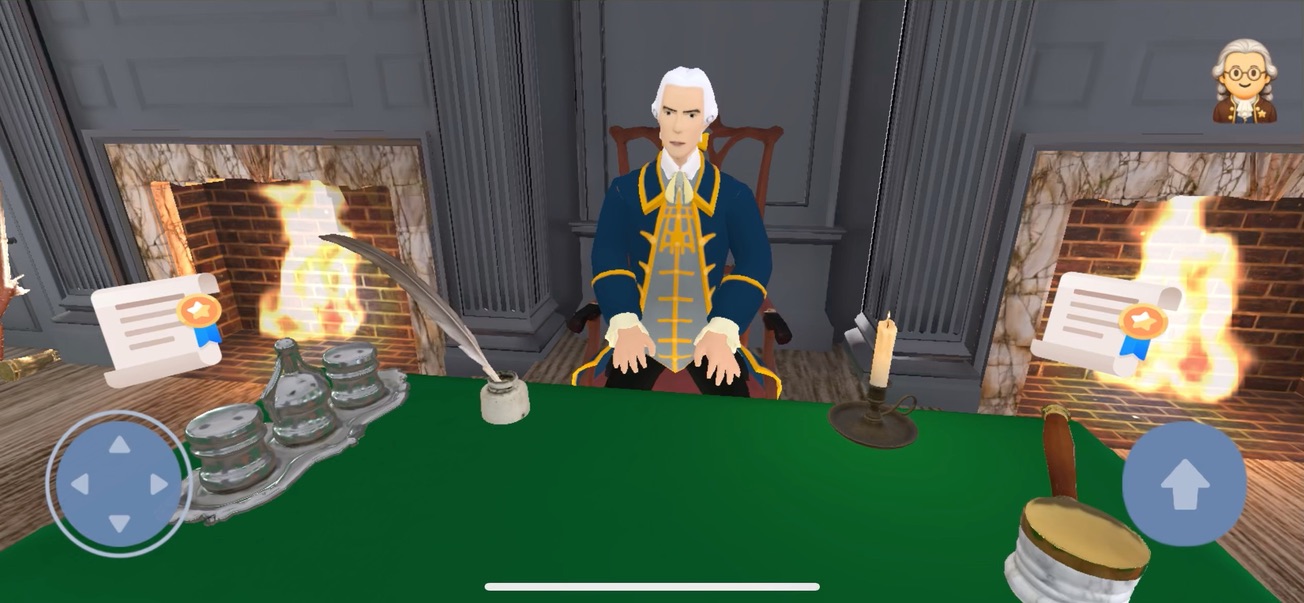
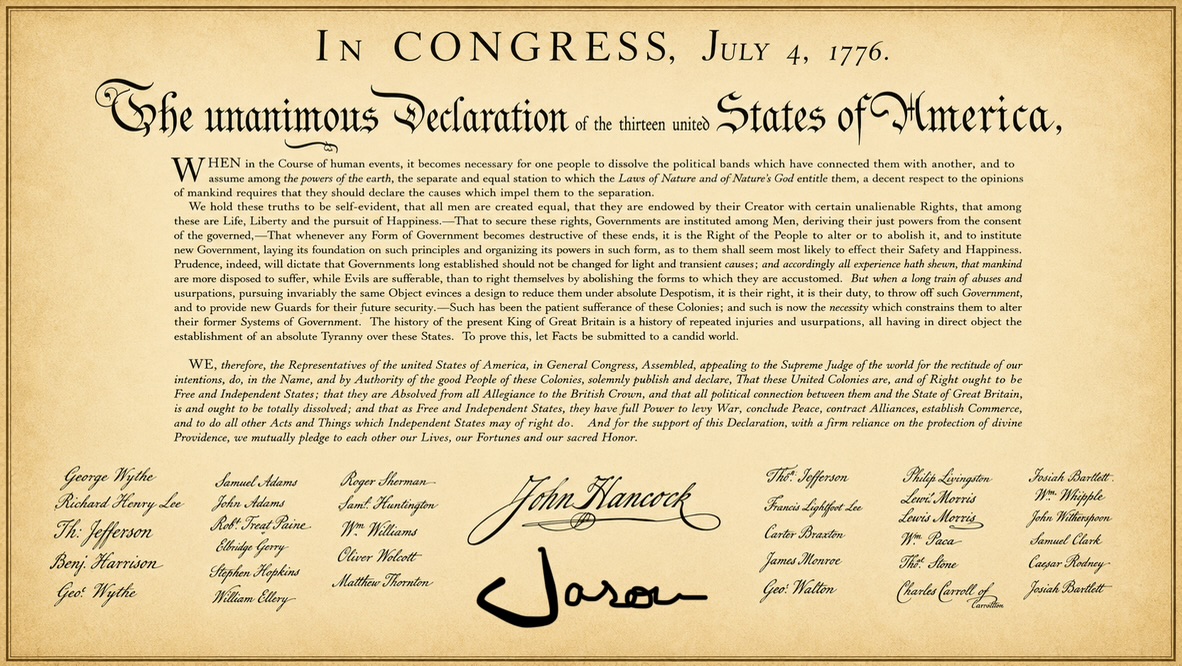
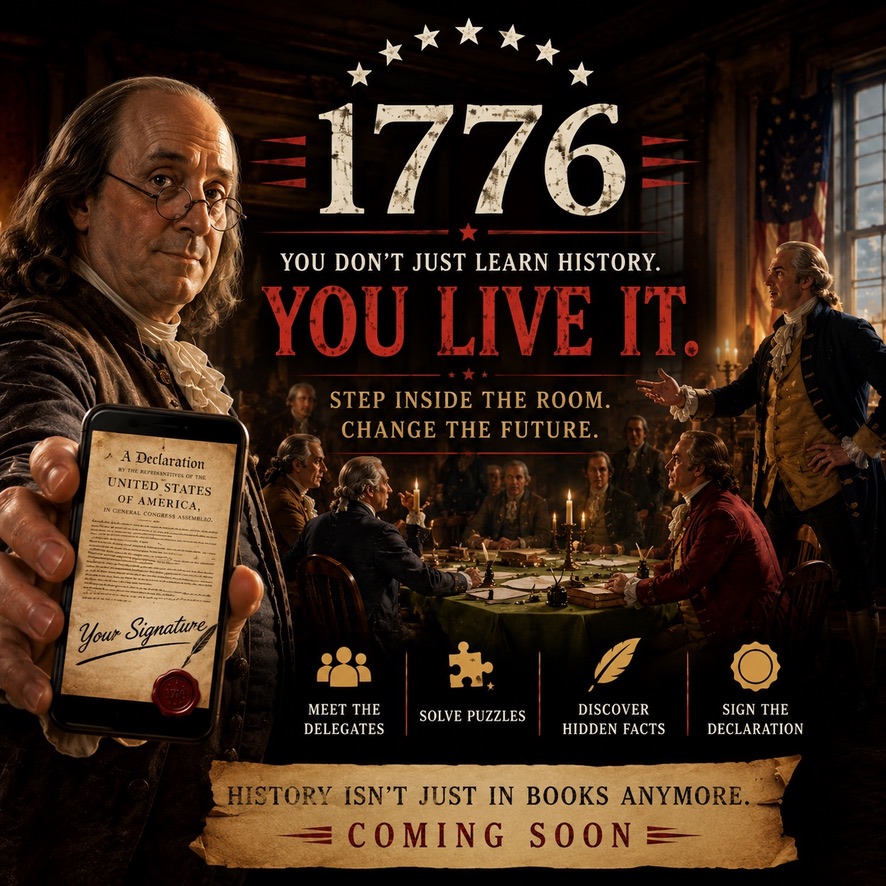
Our app puts a child inside Independence Hall in the summer of 1776. They meet the delegates, they work through the wording of the Declaration with Jefferson — including the arguments about what to cut — and they sign it themselves.
The design intent maps onto the list above: the child generates (choosing and defending wording), retrieves repeatedly (the puzzles require recalling what they were just told), gets dual coding (a spatial room plus text), and ends with a physical act — signing — that anchors the whole sequence to a moment.
The single most common thing parents report back isn’t a test score. It’s that the child came and told them about it. Unprompted. That’s the episodic-encoding signature, and it’s the thing we optimize for.
We also ship a free printable Constitution Day lesson plan precisely because the app alone isn’t the lesson. The consolidation step is where the learning gets fixed.
For curriculum publishers and co-op leaders
If you’re evaluating immersive history for a program rather than a family, the questions we’d want you to ask us are the ones above, plus: what does it cost per seat, what does the teacher do before and after, and what does a child who never opens the app still get?
1776 is a one-time $5 unlock on iPhone and iPad — no subscription — and classroom and co-op sets are available. The Constitution Day lesson plan is free to anyone, app or no app.
Reach us: immersivehistory.com/1776
Sources worth reading if you want the primary literature: Slamecka & Graf on the generation effect; Roediger & Karpicke on retrieval practice; Paivio and Mayer on dual coding and multimedia learning (including the seductive-details effect); Sweller on cognitive load; Lave & Wenger on situated learning; Duke, Fivush & Bohanek on family narrative and the intergenerational self.