

If your child knows one fact about Thomas Jefferson, it’s probably this: he wrote the Declaration of Independence. True — but it’s a strange fact to lead with, because it makes him sound like a man who sat down one afternoon and produced a famous document.
What actually happened is more interesting, and much more useful for a kid to hear.
The short version
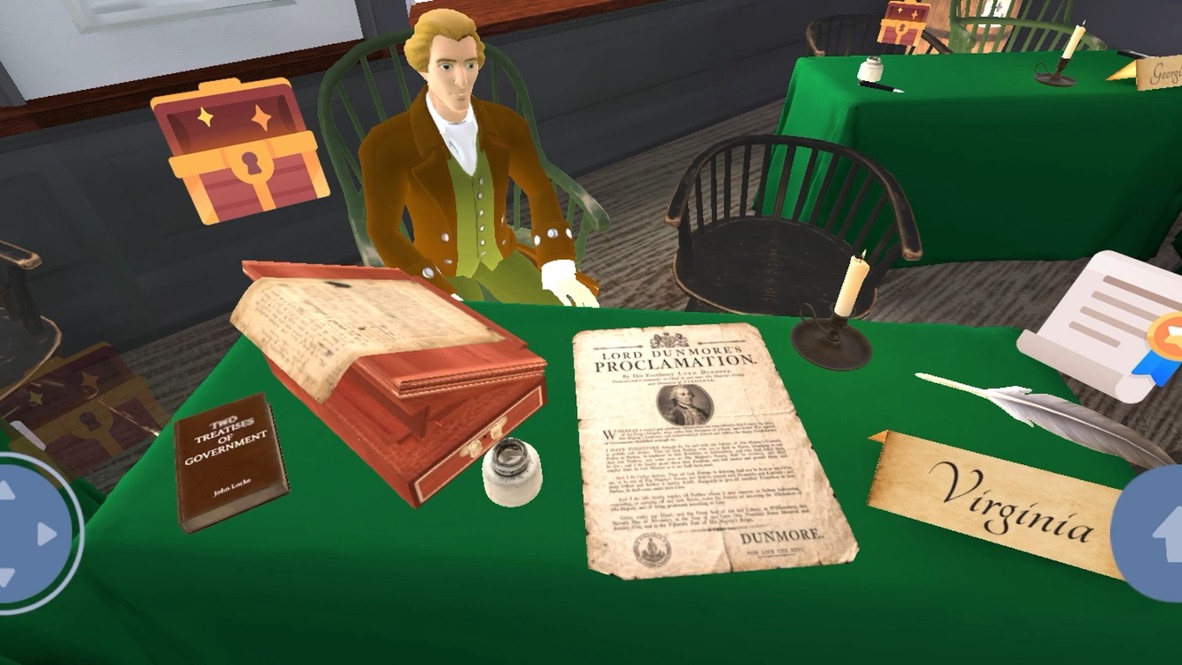
Thomas Jefferson was born in Virginia in 1743. He was a farmer’s son who grew up to be a lawyer, an inventor, an architect, a book collector, a diplomat, and eventually the third President of the United States. He was famously terrible at public speaking and famously good at writing — which is exactly why the Continental Congress handed him the job in June of 1776.
He was thirty-three years old. Most kids are surprised by that. He wasn’t a wise old man in a wig; he was closer to the age of their uncle.
What he was like
Details land better than adjectives, so here are the ones that stick with children:
- He read constantly. He owned around 6,500 books. When the British burned the Library of Congress in 1814, Jefferson sold them his personal library to start it over.
- He tinkered. He designed his own house, Monticello, and kept redesigning it for forty years. He tracked the weather nearly every day of his adult life.
- He hated speaking in public. As President, he stopped delivering the annual message to Congress in person and mailed it in instead. That stayed the custom for over a century.
- He was a terrible businessman. He died deep in debt.
That last one matters. Kids are taught to file founders under “great man,” and it’s worth showing them that great and flawed live in the same person.
Why he wrote the Declaration
In June 1776, Congress picked a committee of five — Jefferson, John Adams, Benjamin Franklin, Roger Sherman, and Robert Livingston — to draft a statement explaining why the colonies were separating from Britain.
Adams later said he pushed Jefferson to write it for three reasons: Jefferson was a Virginian, he was well-liked, and — Adams’s words — he could write ten times better than Adams could.
So Jefferson sat in a rented room in Philadelphia and wrote a draft over about seventeen days. Then the committee edited it. Then Congress edited it again, cutting roughly a quarter of what he wrote. He sat through that process in near-silence, unhappy about it. Franklin, sitting beside him, told him a joke to make him feel better.
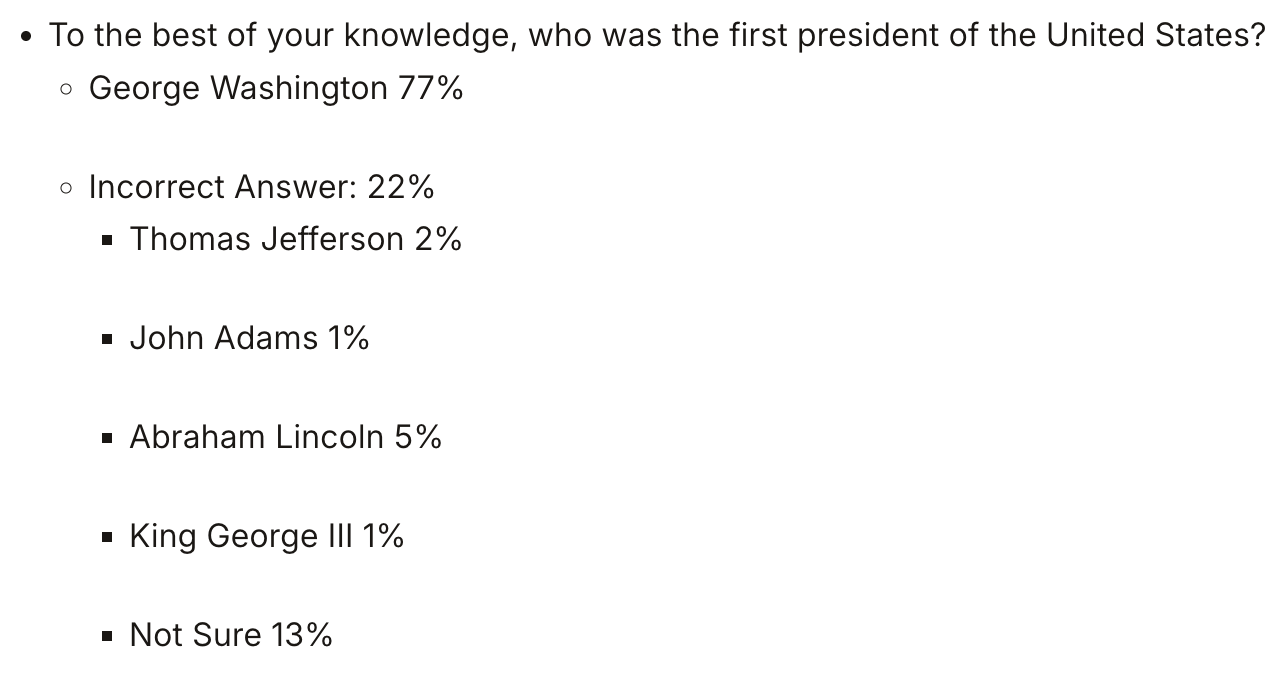
This is the single most valuable thing a kid can learn about the Declaration: it wasn’t handed down. It was drafted, argued over, cut, and rewritten by people who disagreed with each other. It’s a piece of work, not a relic.
The sentence he’s remembered for
“We hold these truths to be self-evident, that all men are created equal, that they are endowed by their Creator with certain unalienable Rights, that among these are Life, Liberty and the pursuit of Happiness.”
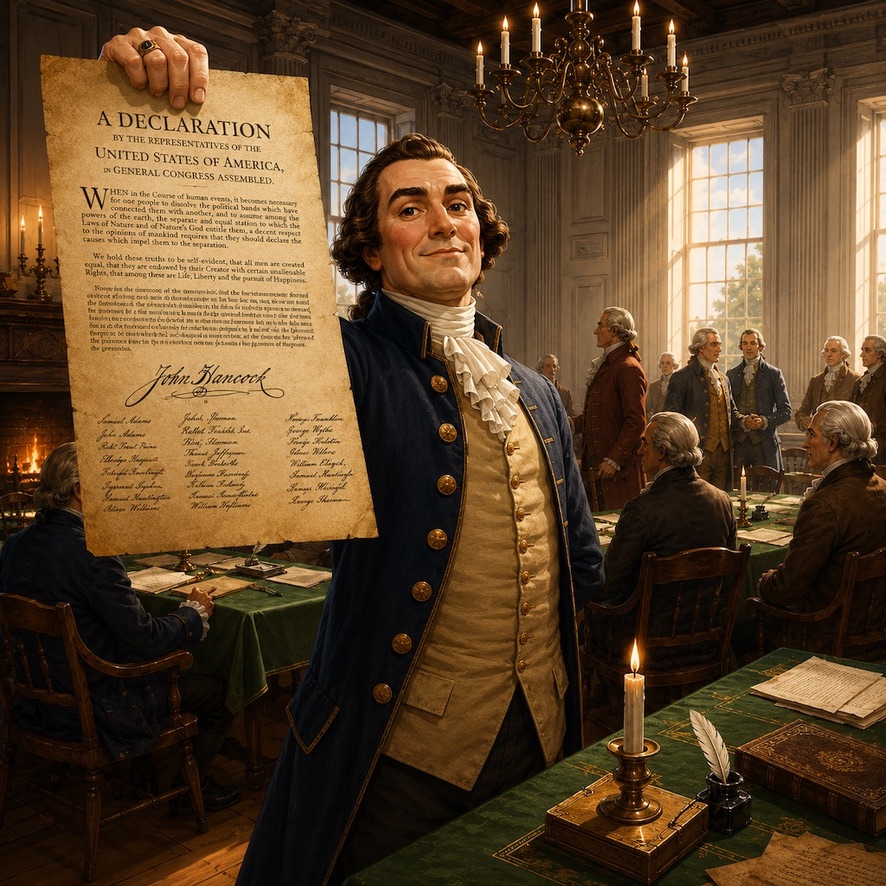
Ask your child what “self-evident” means — that it’s so obviously true you shouldn’t have to prove it. Then ask whether they think everyone in 1776 agreed. (They did not.)
How to talk about the hard part
Jefferson wrote that all men are created equal, and he enslaved more than six hundred people over the course of his life, including at Monticello while he was writing those words.
You don’t have to choose between hiding that and turning the lesson into a demolition. For elementary-age kids, the honest framing is simple:
“He wrote down a promise that was bigger than the way he lived. Americans have been trying to catch up to that promise ever since — and some of the people who used his own words to demand freedom were people he kept enslaved.”
That’s true, age-appropriate, and it hands a child the actual shape of American history rather than a flattened version they’ll feel lied to about at fifteen. Frederick Douglass and Martin Luther King Jr. both quoted the Declaration back at the country on purpose. That’s the thread to follow.
After the Declaration
- 1785–1789 — Minister to France, replacing Franklin. Asked if he was Franklin’s replacement, he said no one could replace Franklin; he was only his successor.
- 1790–1793 — First Secretary of State, under Washington.
- 1801–1809 — Third President. Made the Louisiana Purchase, which doubled the size of the country, and sent Lewis and Clark west.
- 1819 — Founded the University of Virginia, and designed its buildings.
He asked that his gravestone list three things: author of the Declaration of Independence, author of the Virginia Statute for Religious Freedom, and father of the University of Virginia. Not President. Ask your kid why they think he left that off — it’s a genuinely good discussion.
He died on July 4, 1826 — the fiftieth anniversary of the Declaration. John Adams died the same day.
Five questions to ask after the reading
- Why do you think Congress picked a thirty-three-year-old to write it?
- How would you feel if a group edited a quarter of your writing in front of you?
- What does “all men are created equal” mean in your own words?
- Can someone write something true and not live up to it? Have you ever?
- If you had to pick three things for your gravestone, what would they be?
Make it something they walk into
The reason the drafting story matters more than the biography is that kids don’t remember facts about people; they remember being in the room. If your child can picture Philadelphia in June — hot, crowded, arguing, a young man rewriting a sentence for the ninth time — Jefferson stops being a face on a nickel.
That’s exactly what we built 1776 to do. Kids step into Independence Hall, meet the founders, work through the wording of the Declaration with Jefferson himself, and sign it. It’s a one-time $5 unlock on iPhone and Android — no subscription — and it pairs naturally with any founding-era unit study.
Jarom Sidwell spent years in Hollywood visual effects production (Avatar, The Avengers) before founding Immersive History. 1776 lets kids step into Independence Hall, meet the founders, help draft the Declaration, and sign it themselves — available now on iPhone and Android.