The American Revolution is one of the hardest things to teach well to young children — not because it’s boring, but because it’s big. Eight years of war, dozens of names, a political argument about representation that most adults couldn’t summarize on demand. Hand a curious 8-year-old a standard textbook chapter and you’ll watch their eyes glaze in about ninety seconds.
The fix isn’t to simplify the Revolution into a cartoon. It’s to teach it the way it actually happened to the people living through it: as a story about a disagreement that got bigger and bigger until people had to choose sides.
Here’s how to do that with elementary-age kids.
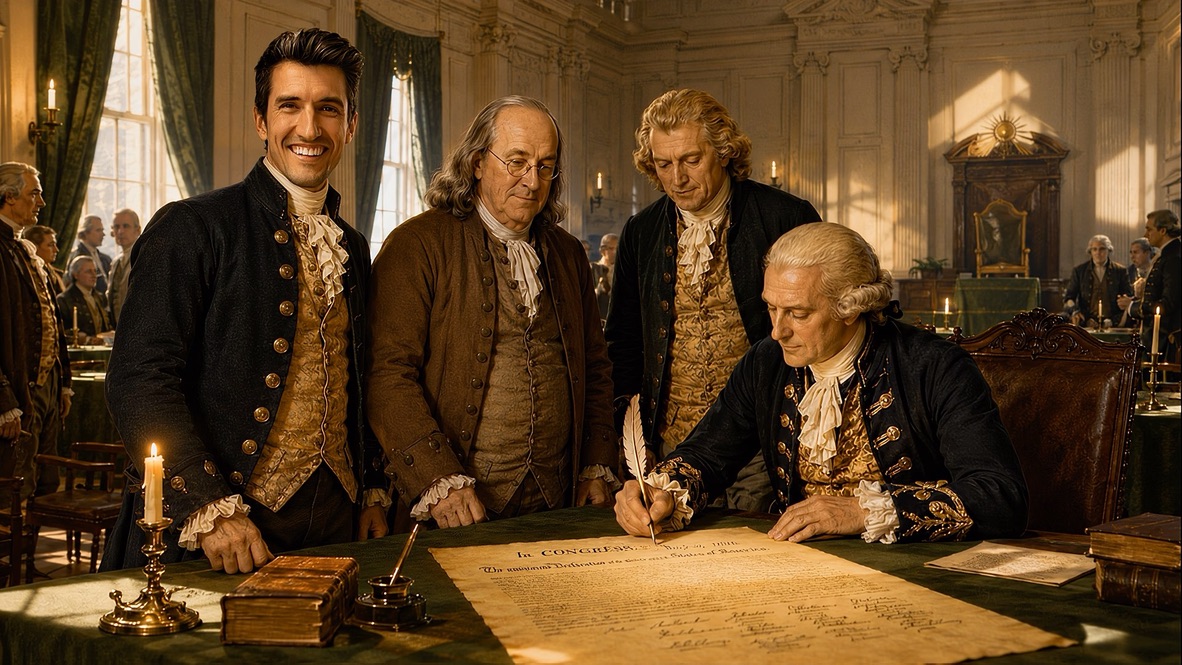
The scene most kids only ever meet as a painting in a textbook.
Start with the disagreement, not the war
Most curricula open with battles. That’s backwards for this age.
Young kids understand fairness before they understand politics. Every 7-year-old on earth has an intuition about “you don’t get to decide that for me.” That’s the whole Revolution in one sentence.
Try opening like this:
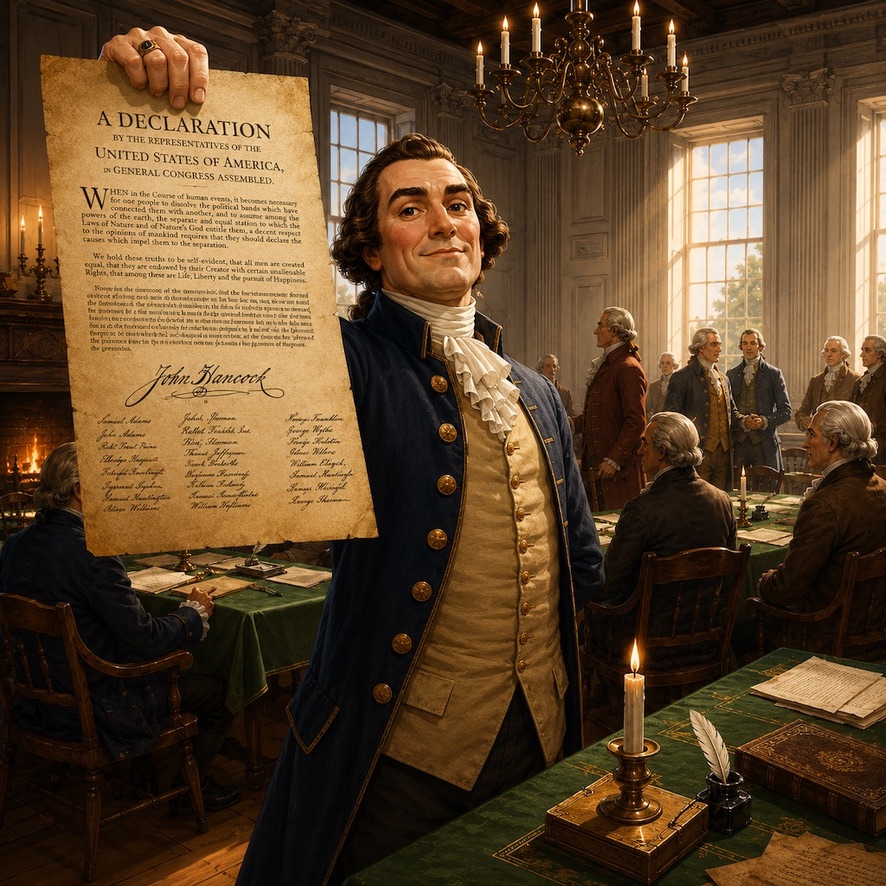
Inside the room where it happened.
“Imagine your family has rules. Now imagine someone who has never met you, who lives very far away, decides they get to make new rules for your house — and you don’t get any say. And when you complain, they say ‘too bad.’ What would you do?”
Let them answer. Let them argue. That conversation is the lesson. The Stamp Act, the Tea Act, “no taxation without representation” — these all become concrete once a child has already felt the unfairness in their own terms.
Rule of thumb: teach the feeling first, then attach the vocabulary. Not the other way around.
Pick six people, not sixty
Elementary kids remember people. They do not remember lists.
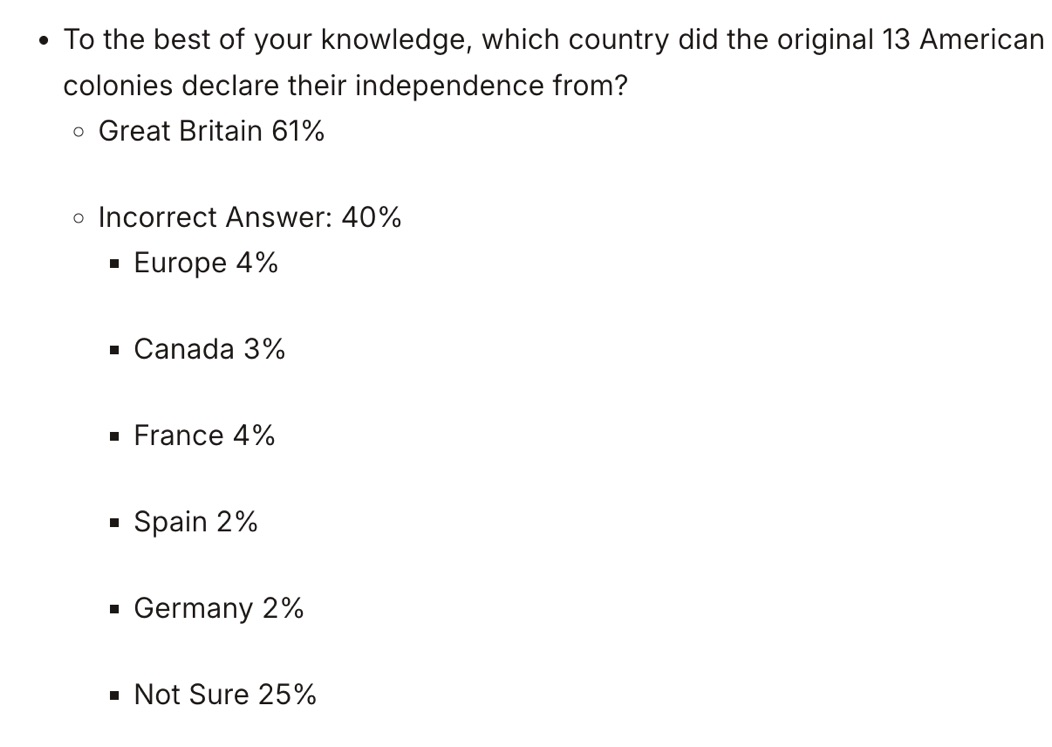
61% knew the colonies declared independence from Great Britain. Source: Cato Institute 2026 4th of July National Survey.
Choose a small cast and stay with them the whole unit so the names accumulate meaning instead of blurring:
George Washington — the reluctant one. He didn’t want to be in charge and kept trying to go home.
Thomas Jefferson — the writer. Young (33!), shy, hated public speaking, wrote the most famous sentence in American history.
Benjamin Franklin — the inventor and diplomat. The funny one, the oldest one, the one who talked France into helping.
John Adams — the stubborn one who pushed everyone toward independence when they’d rather have waited.
Abigail Adams — who wrote to her husband and told him to “remember the ladies.”
A regular kid or soldier — a drummer boy, a printer’s apprentice, a girl in Boston. Someone their size.
Six is enough. If a name comes up that isn’t on your list, mention it and move on. You are not responsible for covering everyone; you are responsible for making a handful of people real.
Use a timeline they can touch
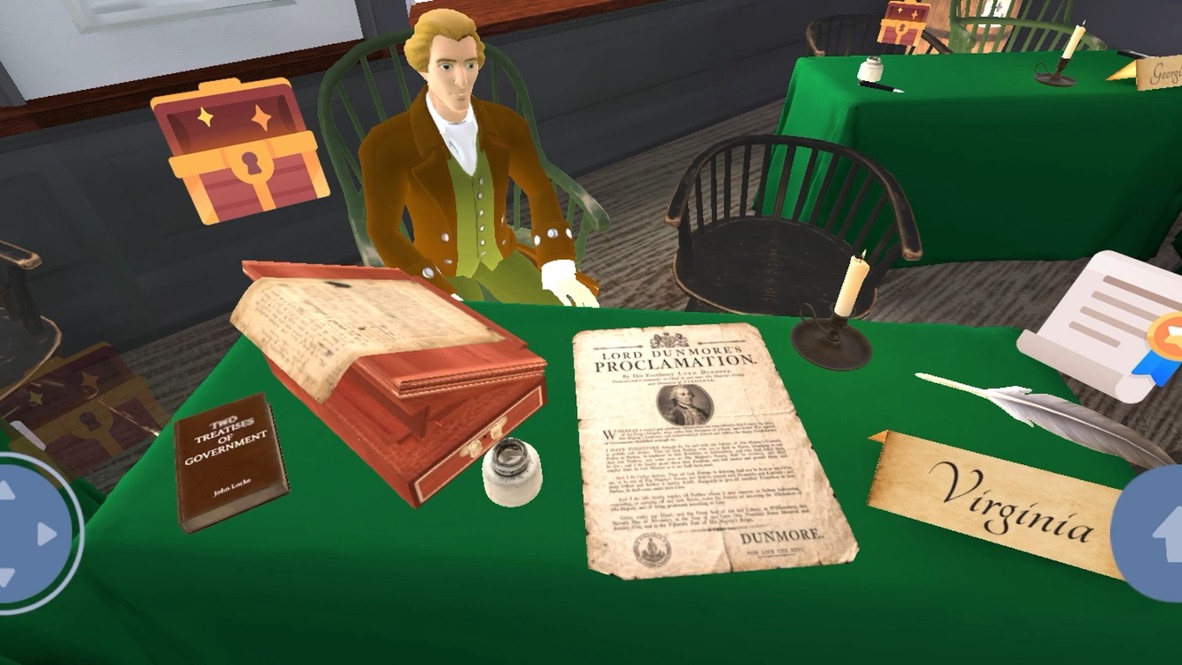
Jefferson’s desk, where kids work through the Declaration’s wording.
Children under about ten don’t have a working sense of historical time. “1776” is just a number. Fix this physically.
Run a strip of butcher paper down a hallway. Mark 1765 at one end and 1783 at the other. Every time you learn something, they draw it and pin it up. By week four they can walk the Revolution — and they’ll start noticing gaps (“what happened in this empty part?”), which is exactly the question you want.
Cheap, low-prep, and it does more for chronological understanding than any worksheet.
A four-week structure that works
The signing screen, after.
You can stretch or compress this, but the shape holds:
Week 1 — Why were they upset? Colonies, king, taxes without a vote. The Stamp Act and the Tea Act. End with the Boston Tea Party — kids love it, and it’s a great chance to ask a real question: was that okay to do? (There’s no wrong answer. The discussion is the point.)
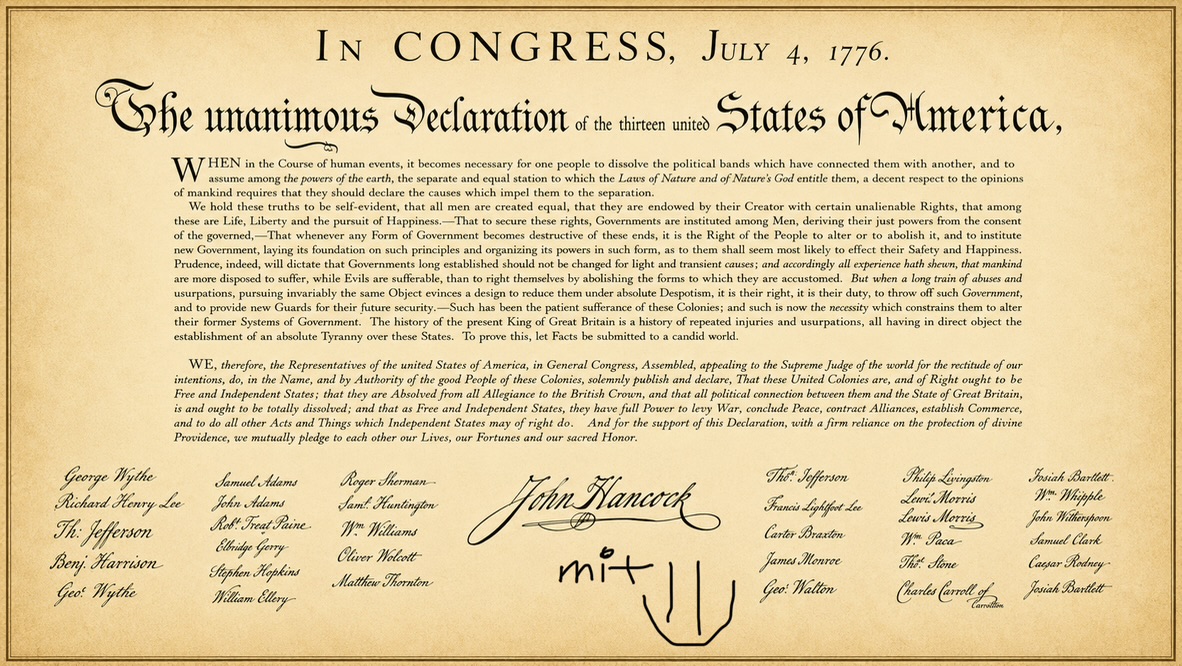
Week 2 — The break. Lexington and Concord. The Second Continental Congress. Then the Declaration of Independence: what it says, why Jefferson wrote it, and what it cost the men who signed it. Read the second paragraph aloud — just that one — and unpack it line by line.
Week 3 — The war years. Not every battle. Pick three: Trenton (the Christmas crossing, hope after disaster), Saratoga (the turning point that brought France in), Yorktown (the end). Spend more time on Valley Forge than on tactics — cold, hunger, and people staying anyway is the part that lands with children.
Week 4 — What did it mean? The war ends; the hard part begins. What the Declaration promised versus who actually got those promises in 1783 — and how long it took for that to change. Elementary kids can hold this. They’re often better at it than adults, because “they said everyone but they didn’t mean everyone” makes immediate, uncomfortable sense to a child.
Read living books, not summaries
Narrative beats summary at every age, and especially at this one. A few that consistently work for elementary readers:
George Washington’s Socks — time-travel adventure, very approachable
Toliver’s Secret — a girl carries a message through occupied New York
Sam the Minuteman — for the youngest readers
Katie’s Trunk — the Revolution from a Loyalist family’s side, which is a genuinely valuable perspective
Johnny Tremain — for stronger readers, usually 5th grade and up
One good story does more than a month of comprehension questions.
Let them do something with their hands
Retention at this age is physical. Some of the highest-return activities:
Write with a quill. A feather, some ink, and ten minutes of frustration teaches more about 1776 than a paragraph about it ever will.
Sign your own declaration. Have each kid write three things they believe and sign it in their biggest handwriting. Then tell them what happened to the men who did that for real.
Encode a message. Revolutionary spy rings used invisible ink and ciphers. Lemon juice and a lamp still work.
Cook something. Johnnycakes, hasty pudding. Food is a time machine.
Take a virtual field trip. Most families can’t get to Independence Hall. But standing in the room — seeing how small it was, where people sat, what the light looked like — changes a child’s relationship to the event. Immersive apps and virtual tours make that possible from a kitchen table.
Skip these (for now)
You have limited attention to spend. Don’t spend it on:
Memorizing battle dates
The full list of signers
Detailed troop movements and military strategy
Every act of Parliament by name
None of it will survive to next year, and all of it competes with the things that will. Save the detail for middle school, when they have a frame to hang it on.
The test of whether it worked
Not a quiz. Ask this instead, at dinner, a week after you finish:
“Why did they do it?”
If your child can tell you — in their own words, however clumsy — that a group of people decided they’d rather risk everything than be ruled by someone who wouldn’t listen to them, the unit worked. Everything else is detail they can pick up later.
Bringing Independence Hall home
We built 1776 for exactly this moment in a child’s education. Kids walk into Independence Hall, meet the founders, help Thomas Jefferson work through the wording of the Declaration, and sign it themselves. It’s the closest thing to a founding-era field trip you can take on a Tuesday afternoon.
It’s live on iPhone and Android — a one-time $5 unlock, no subscription, and it works for the whole family.