The founding era is unusually well-suited to a Charlotte Mason education, and for a reason that has nothing to do with patriotism: the people involved wrote everything down, and they wrote it well.
Mason wanted children fed on living books rather than “twaddle” — predigested summaries with the life squeezed out. The founding generation left behind letters, diaries, pamphlets, and arguments in prose so alive that a nine-year-old can feel the temperature of it. You don’t have to reach for a textbook. The primary sources are the living books.
Here’s how a term of it can look.
The shape of a lesson
Mason’s history lessons were short — twenty minutes at the younger end, thirty or so as children get older — and they followed a rhythm you can repeat all year:
- Read a single passage aloud. One reading, attentively. Not two. The expectation that they will only hear it once is what produces the attention.
- Narrate. Close the book and ask the child to tell it back in their own words. No prompting, no leading questions, no correcting midstream.
- Discuss briefly — one question, not a quiz.
- Copywork or a Book of Centuries entry, on some days but not all.
That’s the whole method. The restraint is the point. Mason’s argument was that the child’s mind does the work of digestion, and that a parent who explains too much is eating the meal for them.
Choosing the books
For the founding era, a term’s spine might look like this — one main book read slowly across twelve weeks, with primary sources woven in:
- A narrative spine. Something with a real author’s voice rather than a committee’s. Genevieve Foster’s George Washington’s World is the classic Mason-friendly choice because it does something unusual: it shows what the rest of the world was doing while Washington grew up.
- A biography read alongside it. Jean Fritz’s short founder biographies (Why Don’t You Get a Horse, Sam Adams?, Can’t You Make Them Behave, King George?) are living books in miniature and very funny, which matters more than people admit.
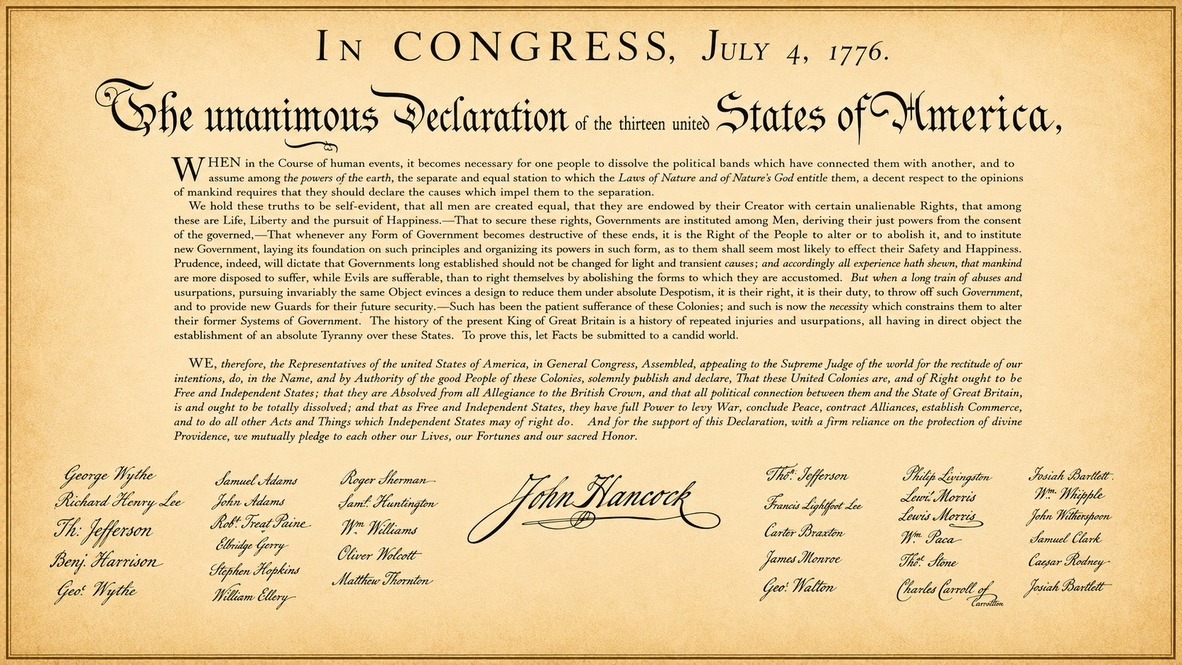
- The documents themselves, in small pieces. The Declaration. Franklin’s Autobiography. Abigail Adams’s letters. Washington’s Farewell Address, later on.
Resist the urge to add more. A term with one spine, one biography, and a handful of primary passages read closely will leave more behind than six books read quickly.
Narration prompts that aren’t quizzes
Narration is not comprehension questioning, and the difference shows up fast. “Tell me what you heard” produces a retelling; “what year was the Declaration signed?” produces a guess.
Some prompts that work for this era:
- Tell me what happened. (The default. Use it most weeks.)
- Tell it as if you were in the room.
- Tell me what Mr. Adams wanted, and what Mr. Dickinson wanted.
- Write a letter from Abigail to John about what you just heard. (Written narration, older children.)
- Draw the room, then tell me about your drawing. (Younger children, or a child who freezes when asked to speak.)
For a child who says “I don’t remember any of it”: read it again next time and say so beforehand. Then stop offering. The habit forms from the expectation.
Copywork from the founding era
Copywork does two things at once — it trains the hand and it plants good sentences in the memory. The founding era is a gift here, because the sentences are short, rhythmic, and worth having.
For younger children (one line at a time):
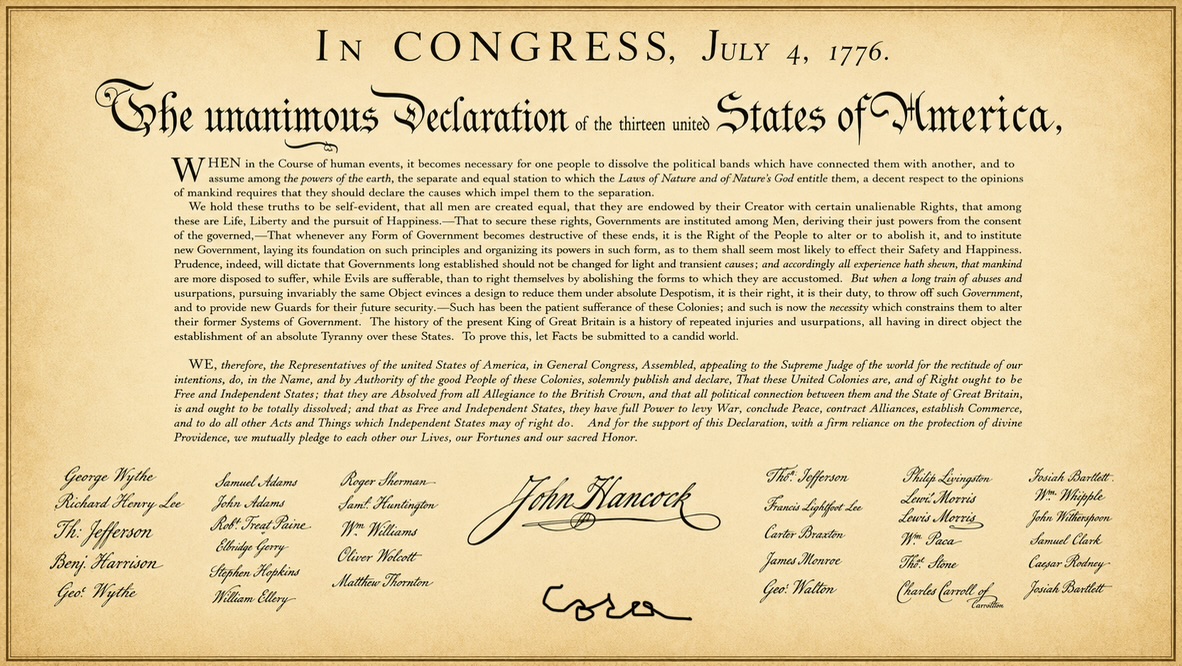
We hold these truths to be self-evident.
…that they are endowed by their Creator with certain unalienable Rights…
Life, Liberty and the pursuit of Happiness.
For middle years:
We hold these truths to be self-evident, that all men are created equal.
Remember the ladies. — Abigail Adams to John Adams, March 1776
I know not what course others may take; but as for me, give me liberty or give me death! — Patrick Henry
For older students (a full passage over several days):
…that whenever any Form of Government becomes destructive of these ends, it is the Right of the People to alter or to abolish it, and to institute new Government…
Let us raise a standard to which the wise and the honest can repair. — George Washington
A few practical notes. Take the passage from the actual document, capitalization and all — the eighteenth-century capitals are part of the texture. Keep the sessions short; four lines done beautifully beats a page done wearily. And read the passage aloud before it is copied, so the child is transcribing something they’ve heard rather than decoding shapes.
The Book of Centuries
If you keep one, the founding era fills a page quickly: 1765 Stamp Act, 1770 Boston Massacre, 1773 Tea, 1775 Lexington and Concord, 1776 the Declaration, 1781 Yorktown, 1787 the Constitution, 1789 Washington’s inauguration.
The value isn’t the list. It’s what sits beside the list — Mozart is composing while the Declaration is being argued over; the first hot-air balloon goes up two years after Yorktown. Mason wanted children to feel that history happens all at once, not in subject-shaped tubes.
One idea per lesson
If there’s a single Mason instinct to carry into this term, it’s this: give the child one idea to hold, not twelve facts to store.
For the founding, the ideas are unusually good ones. That a government can be argued into existence on paper. That the men writing “all men are created equal” did not live up to it, and that the sentence outlived them and was used against them. That the most radical thing in the Declaration is the middle, not the beginning.
A child who leaves a term with three ideas like that has been educated. A child who can list the signers has been quizzed.
Where an immersive experience fits — and where it doesn’t
A fair question for a Mason household: does a screen belong anywhere near this?
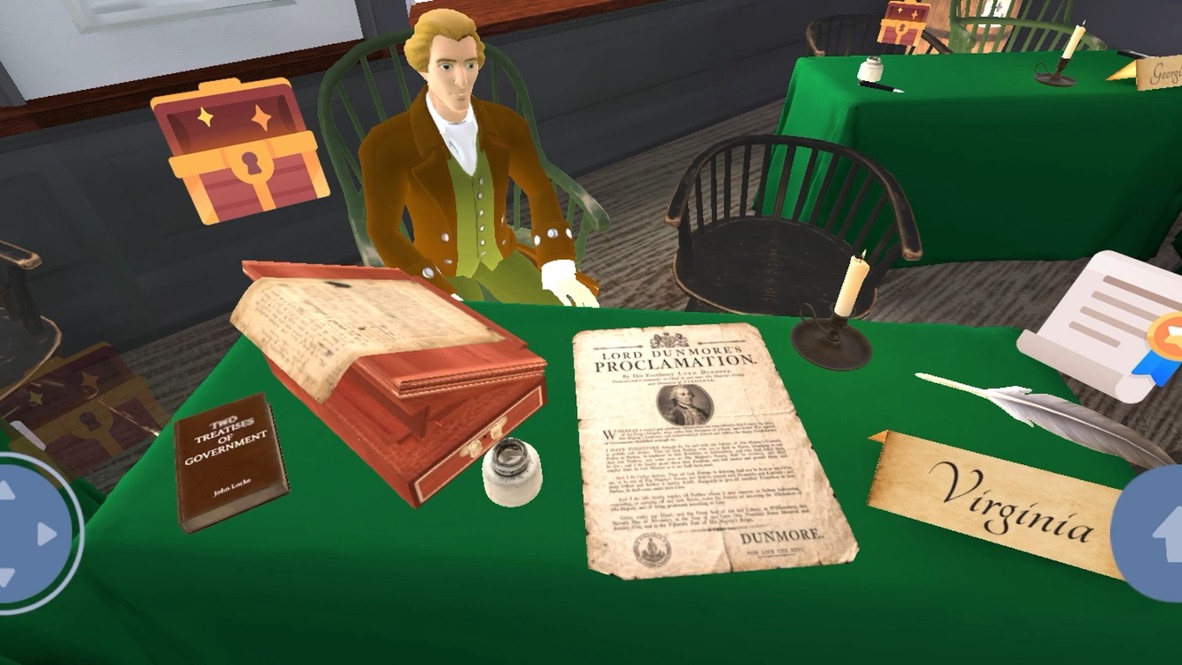
The honest answer is that it doesn’t replace anything above. Narration, living books, and copywork are the work. But there’s one thing an immersive experience does that a book can’t, and it’s the thing Mason cared about most — it gives the child something to tell you about. Place is the raw material of narration, and most children have never stood in a room like Independence Hall.
In 1776, kids walk into the hall, meet the delegates, work through the wording of the Declaration alongside Jefferson, and sign it themselves. Used well, it isn’t a lesson — it’s an experience you narrate afterward, the same way you would a field trip. Ask for the narration when they come out. You’ll get more than you expected.
1776 is free to download on iPhone and iPad, with a one-time $5 unlock for the full experience. immersivehistory.com/1776
Constitution Day is September 17. If you’re planning a lesson, our free one-page plan and classroom sponsorship details are at immersivehistory.com/1776.