
There is a lot of America 250 material out there right now, and most of it falls into one of two categories: a beautiful landing page with nothing behind it, or a 200-page PDF nobody will ever finish.
This is a sorted list. Free things first, because most families should start there. Paid things second, with honest notes about who each one is actually for. And at the end, the short list of what I’d skip.
Full disclosure: I make one of the paid things on this list. I’ve put it in the paid section with the same treatment as everything else, and I’ll tell you plainly who it isn’t for.
Start here: the free things worth your time
1. The primary sources themselves
The single most underrated America 250 resource is the actual text of the Declaration and the Constitution — free, public domain, three pages between them.
- National Archives, Founders Online — searchable letters and papers of Washington, Adams, Jefferson, Franklin, Hamilton, and Madison. Free.
- The National Archives “Charters of Freedom” — high-resolution images of the engrossed Declaration and Constitution. Print one. Let a child look at the real handwriting and the real signatures.
- The Library of Congress primary source sets — pre-assembled, teacher-facing, with framing questions already written.
Who it’s for: every family, at every age. A nine-year-old will not read the Declaration cold, but a nine-year-old will absolutely lean in when you read the grievances aloud and ask “does that sound fair to you?”
The honest catch: these are raw materials, not a lesson. You supply the teaching.
2. Constitution Day materials (Sept 17)
Constitution Day is federally mandated — every school receiving federal funds has to hold an educational program on September 17. That mandate has produced a surprising amount of free, well-made material that homeschoolers can use just as easily as schools:
- National Constitution Center — the Interactive Constitution, with scholars from across the political spectrum writing on each clause. This is the rare civics resource that treats disagreement honestly.
- iCivics — free games and lesson plans, strongest for middle school and up.
- Bill of Rights Institute — free lessons, primary source readers, and a big library of short explainer videos.
Who it’s for: grades 4 and up, mostly. Below that, you’ll be adapting.
3. Your state’s America 250 commission
Nearly every state has one, most have a public events calendar, and many are actively looking for families to participate. This is the least-used resource on the list and often the most rewarding — local reenactments, museum days, essay contests, and free programs that never make it to a national roundup.
Search “[your state] America 250” or “[your state] semiquincentennial commission.”
Who it’s for: families who’d rather do one memorable thing in person than fifteen worksheets.
4. DAR and SAR chapter programs
The Daughters and Sons of the American Revolution run youth history programming as a core charter activity, and local chapters are actively looking for ways to mark the 250th. Many will come to a co-op and present for free.
Who it’s for: co-ops and groups more than individual families.
5. Free printable lesson plans
There are a lot of these. Most are worksheets in a trench coat. The ones worth downloading share three traits: they fit in one class session, they don’t require materials you have to buy, and they end with a discussion rather than a fill-in-the-blank.
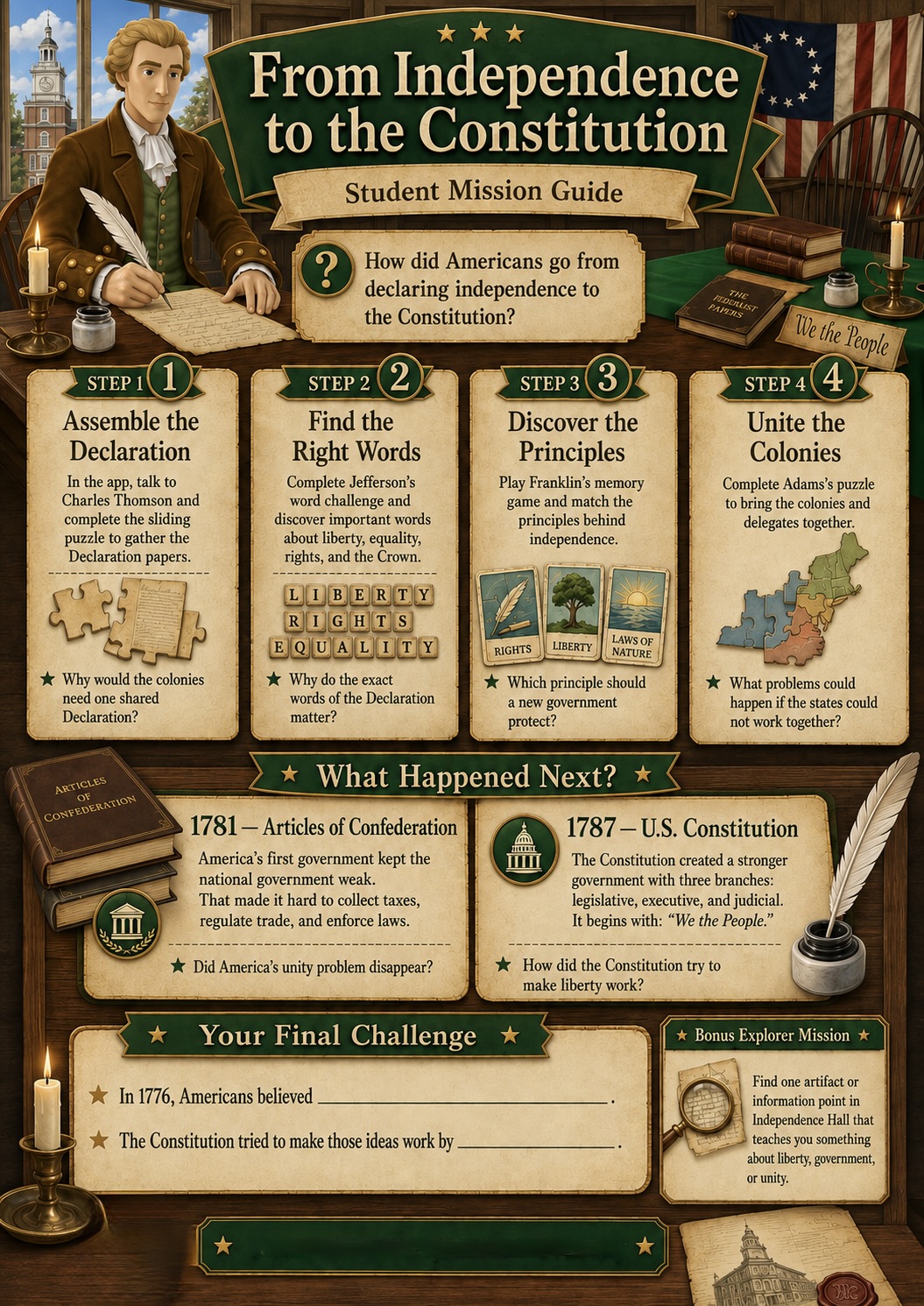
We publish one of these — a free 45-minute Constitution Day plan for grades 3–8 built around a single idea: the Declaration says why, and the Constitution says how. No prep, no app required, printable.
Who it’s for: anyone who needs something ready for Sept 17 and doesn’t want to build it.
The paid things — and who each one is actually for
Full curriculum providers
The Good and the Beautiful, Sonlight, My Father’s World, Notgrass, Beautiful Feet Books, Masterbooks — most of the major providers have American history sequences that cover the founding era well, and several have released 250th-themed supplements this year.
Who it’s for: families who want their whole year handled. If you already use one of these, you probably don’t need to add another curriculum — you need supplements.
The honest note: don’t buy a second full curriculum for a single anniversary year. That’s the most common America 250 overspend I hear about.
Living books and read-alouds
The founding era is unusually well served here. Jean Fritz’s biographies (And Then What Happened, Paul Revere?, Why Don’t You Get a Horse, Sam Adams?) remain the gold standard for elementary. For middle grades, Johnny Tremain and Chains still work. Most are available used for a few dollars, or free at the library.
Who it’s for: everyone. Highest value per dollar on this entire list.
Hands-on kits and reenactment gear
Colonial craft kits, quill-and-ink sets, tricorn hats, candle-dipping. Varies wildly in quality.
Who it’s for: younger kids, and families who learn by doing. Buy one good thing rather than a bundle.
The honest note: a quill, a bottle of ink, and a printed copy of the Declaration costs under $15 and does most of what a $60 kit does.
Immersive and digital experiences
This is the newest category and the one I work in, so here’s the plain version.
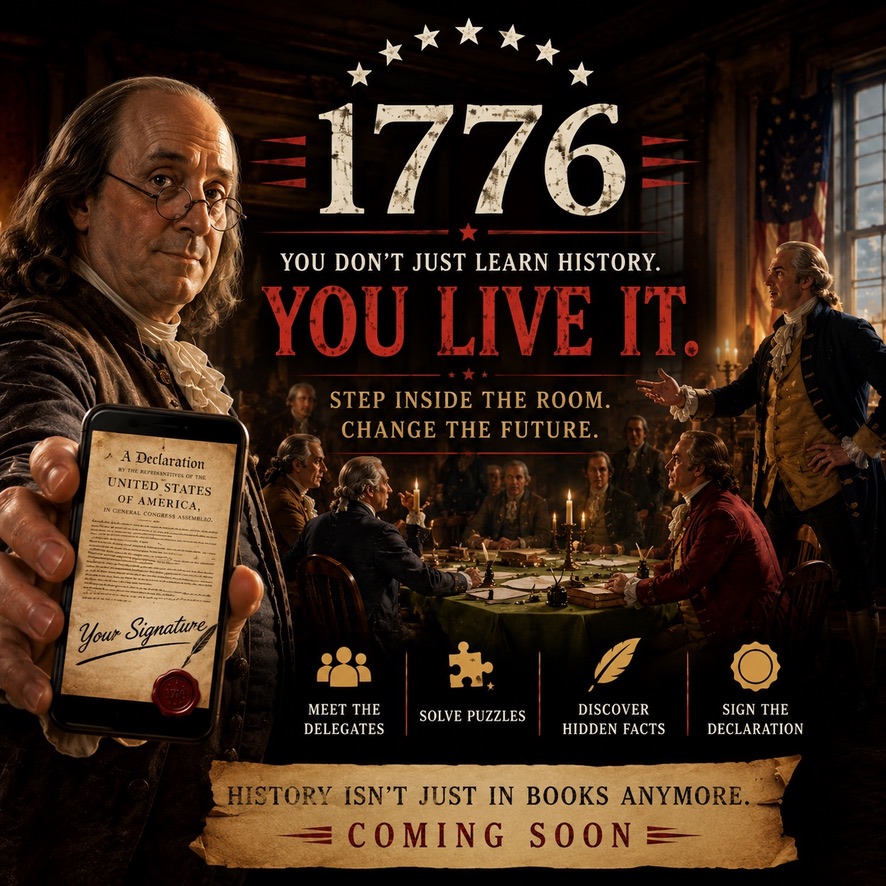
1776 is an app my studio makes. Kids walk into Independence Hall, meet the founders, work through the wording of the Declaration with Jefferson, and sign it themselves. It’s live on iPhone and iPad with a free tier and a one-time $5 unlock — no subscription.
Who it’s for: kids who bounce off the textbook. Reluctant readers. Kids who need to do history rather than read it. It works especially well as the thing that happens before the reading, because a child who has stood in the room asks better questions about the document.
Who it isn’t for: if you have a child who already devours history books, you don’t need this. Buy them three more Jean Fritz biographies and you’ll get more out of the money. I’d rather tell you that than sell you something you don’t need.
Virtual field trips — several museums, including Colonial Williamsburg and Mount Vernon, offer paid live virtual programs with a real interpreter. Excellent for co-ops splitting a cost.
Paid magazines and periodicals
Cobblestone (American history for ages 9–14) is still one of the better recurring purchases in the space, and the 250th has produced a strong run of issues.
What I’d skip
“250 activities” mega-bundles. Almost always a repackaging of free printables. You will use nine of them.
Anything that promises to make history “finally fun” without telling you how. Ask what the child actually does in the first ten minutes. If the answer is “reads a passage and answers questions,” it’s a worksheet.
Partisan framing in either direction. The founding is genuinely interesting and genuinely contested, and children can hold both of those at once. Material that flattens it into a slogan is teaching them less than the real story does — and, practically speaking, it’s the material that will embarrass you in three years.
A second full curriculum. Said twice on purpose.
If you only do four things this year
- Print the Declaration. Read the grievances out loud. Ask whether they sound fair.
- Do something in person — a state 250th event, a reenactment, a DAR chapter program, a museum day.
- Read one good living book as a family.
- Mark Constitution Day on Sept 17 with something that takes 45 minutes and requires no prep.
That’s a genuinely good 250th year, and three of those four are free.
The dates worth putting on your calendar
The 250th isn’t one day — it runs into 2027, and the anniversaries land inside the story itself:
| Date | What it marks |
|---|---|
| Sept 17, 2026 | Constitution Day |
| Nov 11 / Nov 26, 2026 | Veterans Day / Thanksgiving |
| Dec 25–26, 2026 | 250th of Washington crossing the Delaware, and Trenton |
| Jan 2–3, 2027 | 250th of Second Trenton and Princeton — the “Ten Crucial Days” |
| July 4, 2027 | Independence Day |
Christmas night, 1776, is one of the best stories in American history and almost nobody teaches it. Put December 26 on the calendar now.
Jarom Sidwell spent years in Hollywood visual effects production — Avatar, The Avengers — before founding Immersive History, which builds history experiences for kids. The free Constitution Day lesson plan mentioned above is at immersivehistory.com/1776.
<