

This is the school year. America turns 250 in the middle of it, and every homeschool parent I talk to has the same two feelings at once: I want to do something real with this, and I do not have time to build a curriculum from scratch.
So here is a six-week unit study you can run as-is, stretch to twelve, or raid for parts. It’s built for grades 3–8, works with mixed ages, and assumes you have a library card and about forty-five minutes a day.
Before you start: pick your one big question
A unit study without a spine turns into a pile of activities. Pick one question and let every week answer part of it. My favorite for this age range:
“Why did they think it was worth it?”
Everything — the taxes, the tea, the pamphlets, the signatures — hangs off that. Write it on a card and put it where you do school. Ask it out loud at the end of each week.
Week 1 — The world before the argument
The idea: Colonists in 1750 thought of themselves as British. Something had to change for that to break.
- Read aloud: a colonial-life picture book or the opening chapters of a living book on the Revolution.
- Map work: label the thirteen colonies. Do it once now, and again in week six from memory.
- Hands-on: a colonial trade or chore — candle dipping, butter shaking, quill and ink.
- Narration prompt: “Tell me one thing about a colonial kid’s day that you’d like and one you’d hate.”
Week 2 — Taxes, tea, and fairness
The idea: The fight wasn’t really about money. It was about who gets to decide.
- Read aloud: the Stamp Act, the Boston Massacre, the Tea Party.
- Primary source (short): a few lines of colonial protest writing. Read it, then translate it into your kid’s own words.
- Hands-on: run a “taxation without representation” day at home — tax their Legos, make a rule they had no say in, then talk about how it felt. This one lands hard and takes ten minutes.
- Narration prompt: “Was the Tea Party fair? Say why.”
Week 3 — The people
The idea: Kids remember people long after they’ve forgotten dates.
- Pick three: one famous (Washington, Franklin, Jefferson), one lesser-known (Abigail Adams, John Dickinson, Haym Salomon), one their own choice.
- Output: a one-page portrait sketch and three sentences each, or an oral “introduce this person to the family” at dinner.
- Narration prompt: “Which of your three would you want on your side in an argument?”
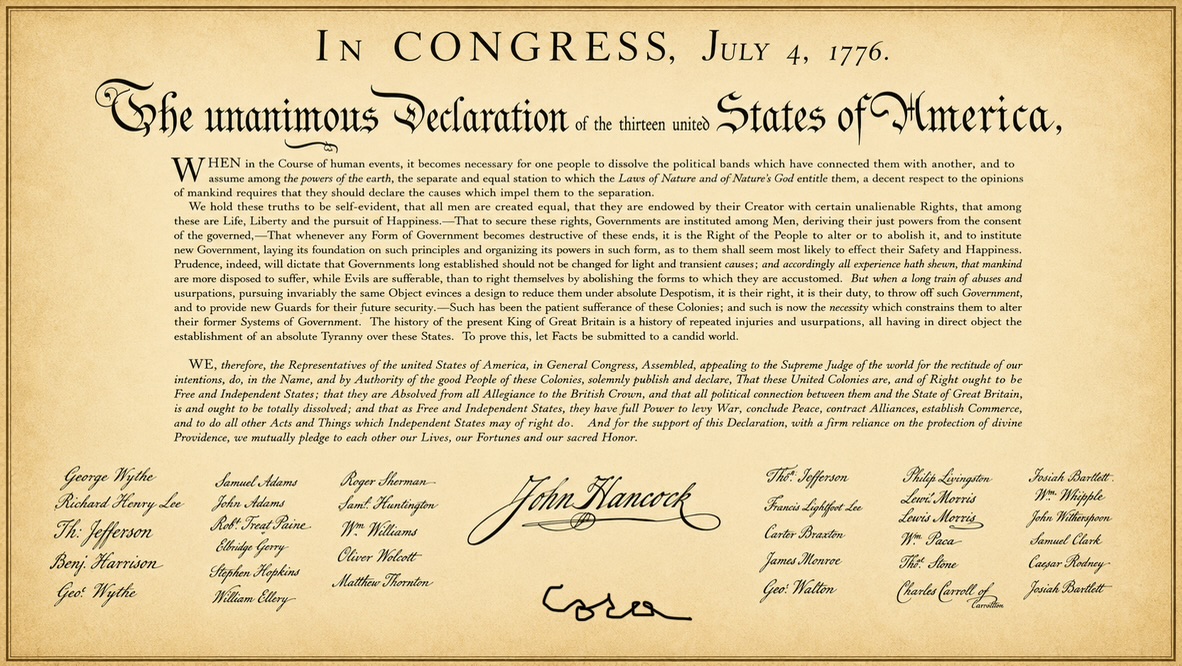
Week 4 — The Declaration itself
This is the heart of the unit. Give it the whole week.
- Read: the preamble aloud, slowly, more than once. Skip the grievance list for younger kids or skim three of them.
- Vocabulary: unalienable, endowed, consent, tyranny. Four words, five days.
- Copywork: “We hold these truths to be self-evident…” — as much as their hand can take.
- Discuss: Jefferson wrote a draft. Congress edited it — hard. Ask: why would a committee change a writer’s words? What’s gained, what’s lost?
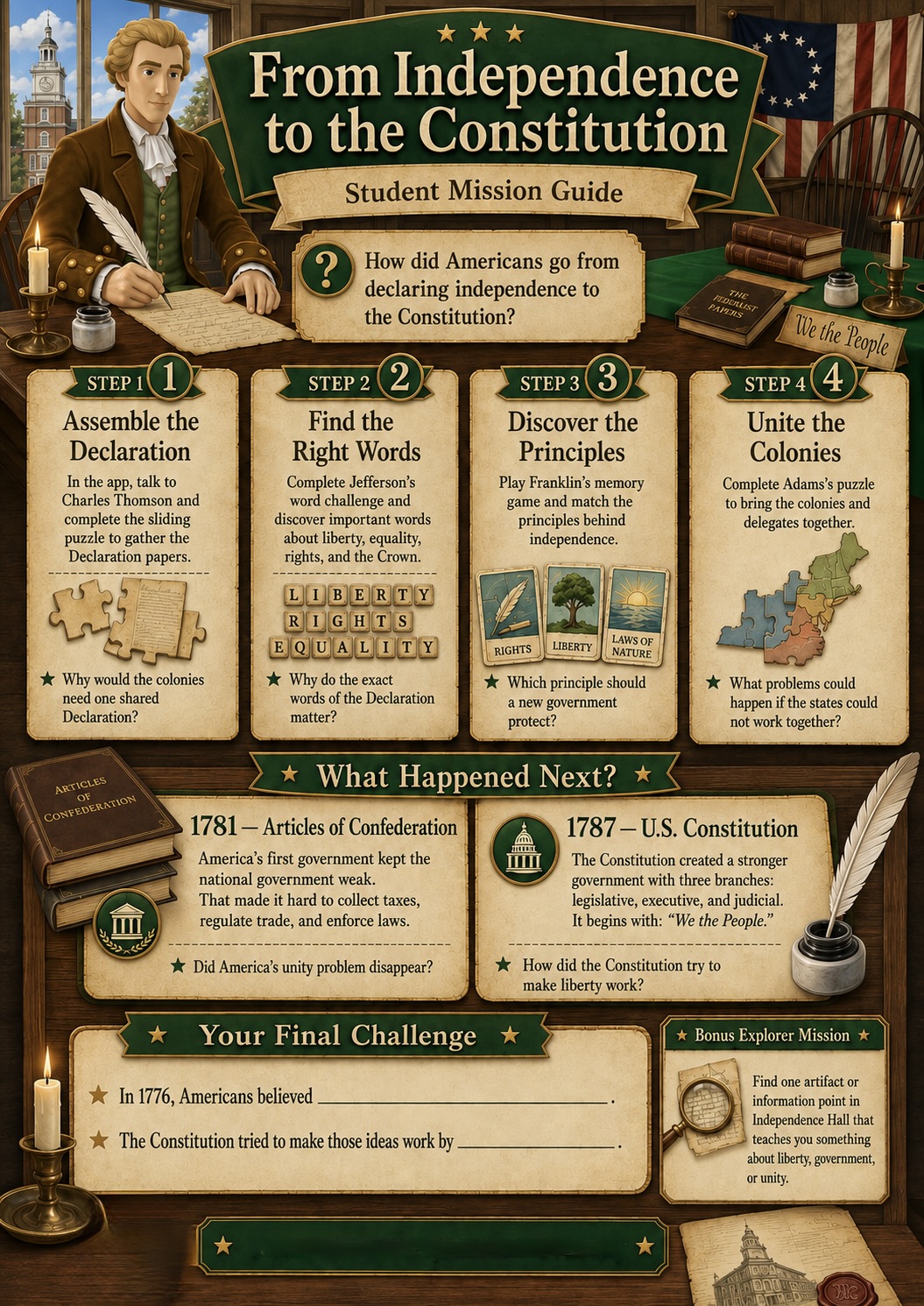
- Experience it: this is the week to make the signing physical rather than abstract. Reenact the debate at your kitchen table with roles, or walk into the room itself — our app 1776 lets kids meet the founders, work through the wording of the Declaration with Jefferson, and sign it themselves. It’s a one-time $5 unlock on iPhone and Android, no subscription. Either way, the goal is the same: they should come away having done something, not just heard about it.
- Narration prompt: “What were they promising, and who did they leave out?” (Yes, ask the second half. Honest history is sturdier.)
Week 5 — The war, briefly
The idea: Signing it was a promise. Keeping it took eight years.
- Read aloud: Lexington and Concord, Valley Forge, Yorktown. Three moments, not a full military history.
- Timeline: a paper strip across the wall, 1765 to 1783. Add every event from weeks 1–5.
- Hands-on: a soldier’s-rations meal, or a marching-distance walk with a loaded backpack.
- Narration prompt: “What kept them going through Valley Forge?”
Week 6 — So what? Bringing it home
The idea: The 250th is about now, not just then.
- Local history: find one Revolutionary-era or 250th-anniversary site, event, or marker near you. Most states have a 250th commission with a public calendar.
- Big project (pick one): a family declaration of independence with real grievances (usually hilarious, occasionally pointed); a museum-style display of the unit’s work; a five-minute talk for grandparents.
- Map work again: thirteen colonies from memory.
- Close the loop: ask the spine question — “Why did they think it was worth it?” — and write their answer down. Keep it. It’s a better keepsake than the crafts.
How to adapt it
- Younger (K–2): read-alouds, map coloring, and the hands-on projects only. Drop the primary sources and copywork.
- Older (9–12): add the full grievance list, the Declaration-vs.-Constitution distinction, and one argumentative essay on the spine question.
- Multiple ages together: same read-aloud, different outputs. Little ones narrate, big ones write.
- Short on time: run weeks 2, 4, and 6. That’s the argument, the document, and the “so what” — the unit still holds.
A note on assessment
Don’t quiz it. Ask them to tell you about it. If a kid can explain to a grandparent why colonists were angry and what the Declaration promised, the unit worked. Narration is the assessment.
Jarom Sidwell spent years in Hollywood visual effects production (Avatar, The Avengers) before founding Immersive History. 1776 lets kids step into Independence Hall, meet the founders, help draft the Declaration, and sign it themselves — available now on iPhone and Android.