

Ask most adults who signed the Declaration of Independence and you’ll get one confident answer: John Hancock. Ask for a second name and the room goes quiet.
That’s a shame, because the signers are where the Declaration stops being a document and starts being a story about people. Fifty-six of them. Some famous, most not. A few teenagers away from home, a few grandfathers. All of them writing their names on a piece of paper that, if things went badly, was a confession of treason.
Here’s what your kids actually need to know — and what’s worth skipping.
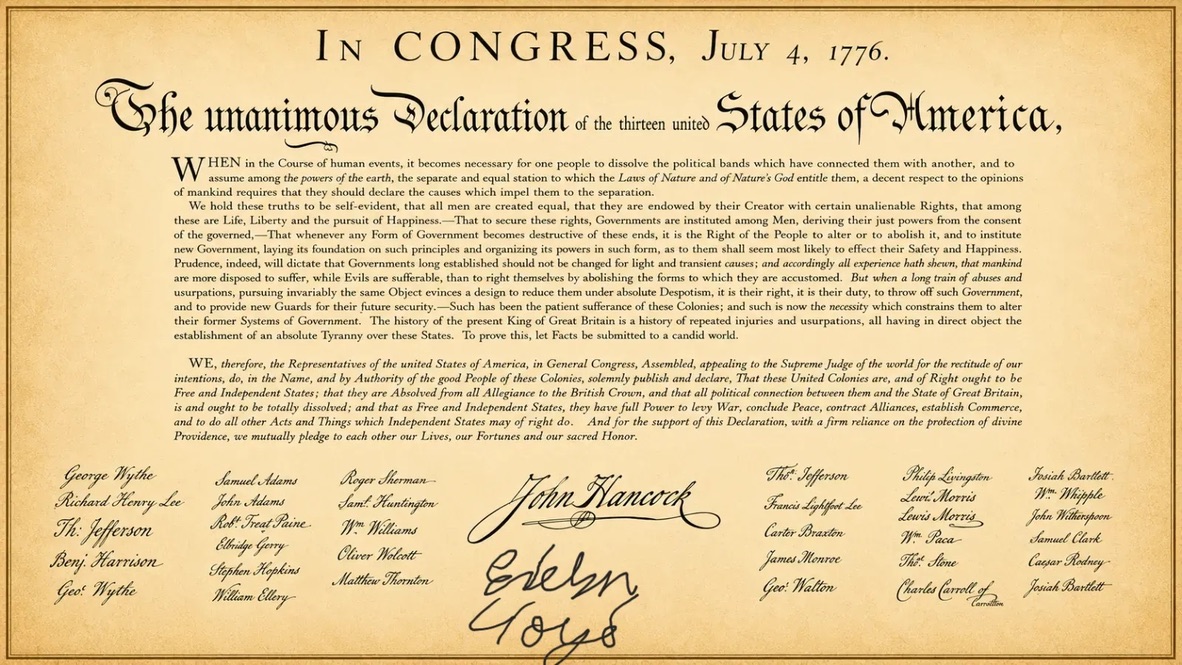
The short answer
Fifty-six men signed the Declaration of Independence. They were delegates to the Second Continental Congress, sent from the thirteen colonies to decide what to do about Britain. They ranged in age from 26 (Edward Rutledge of South Carolina) to 70 (Benjamin Franklin of Pennsylvania).
They did not all sign on July 4, 1776. More on that in a minute — it’s the single best “wait, really?” fact in this whole subject.
The signing didn’t happen the way the painting shows
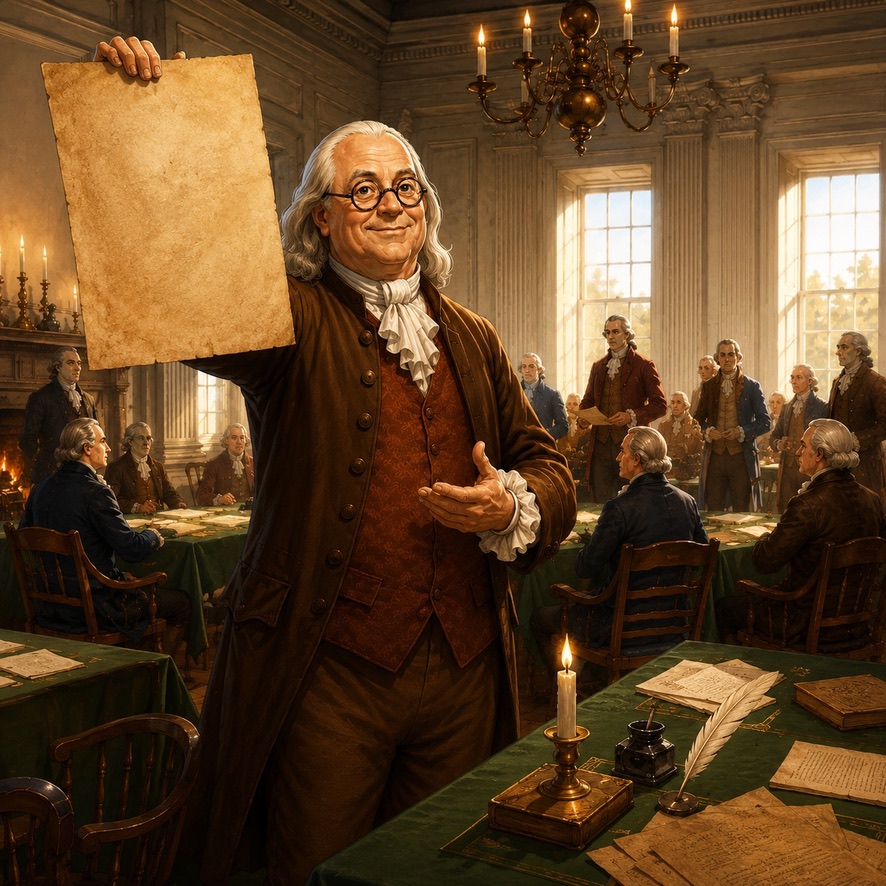
You’ve seen the painting: a crowded room, everyone gathered, the moment captured. John Trumbull’s painting is beautiful and it is not a photograph.
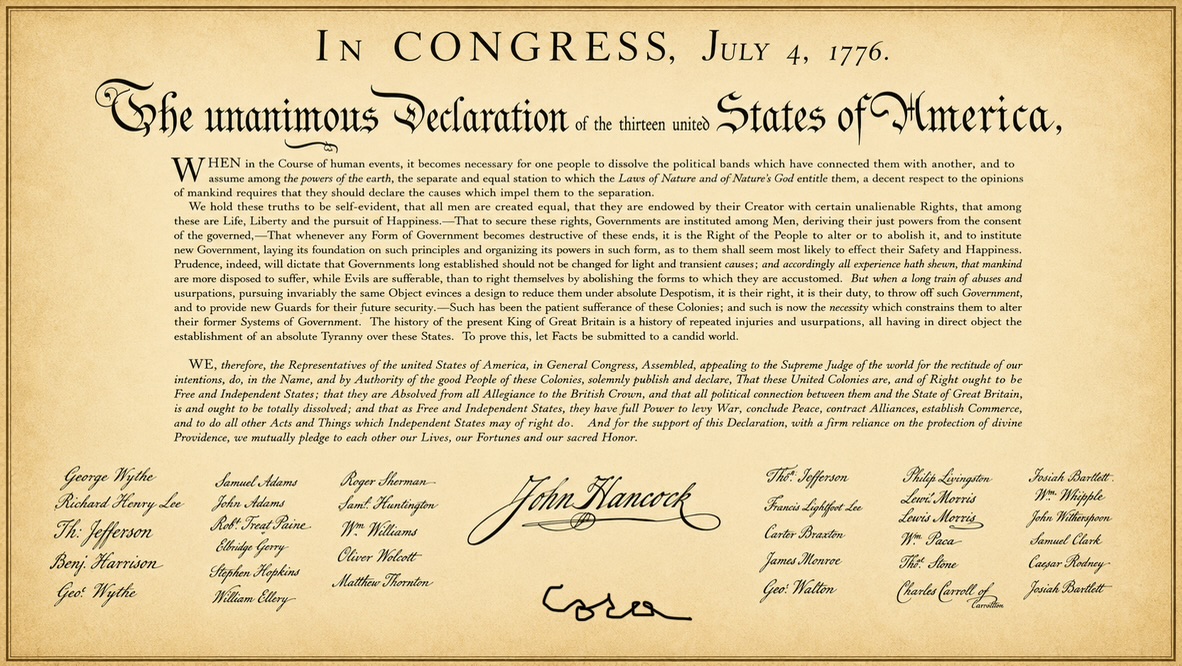
Here’s what actually happened:
- July 2, 1776 — Congress voted for independence. This was the real decision. John Adams thought July 2 would be the day Americans celebrated forever. He was off by two days.
- July 4, 1776 — Congress approved the wording of the Declaration. This is the date printed at the top, which is why it’s the date we celebrate.
- August 2, 1776 — Most of the delegates signed the big handwritten copy (the “engrossed” copy) that sits in the National Archives today.
- Later in 1776 and into 1777 — A handful of delegates who weren’t in Philadelphia in August signed whenever they got there. The last signer, Thomas McKean, may not have signed until 1777.
So the honest answer to “when was it signed?” is: over about seven months, in stages. Kids love this. It punctures the tidy version and replaces it with something better — real people with travel problems and sick relatives and jobs.
John Hancock and the giant signature
Hancock was President of the Continental Congress, so his name goes first, in the center, and it is enormous.
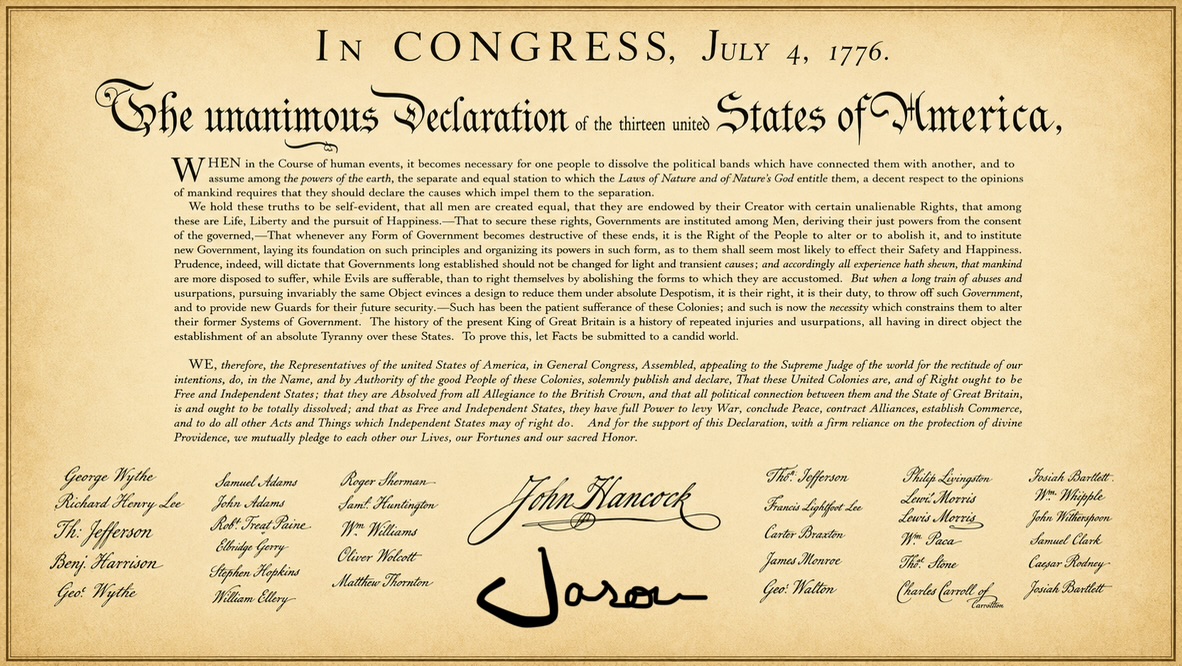
The famous story is that he signed big so King George III could read it without his spectacles. There’s no evidence he ever said that — it’s a legend that grew later. The likelier explanation is simpler: he was the presiding officer, his signature went in the place of honor, and he had a naturally showy hand.
It’s still worth telling kids the legend and the correction. Learning that a great story might not be true, and that we can check, is most of what history actually teaches.
Names worth knowing (and one story each)
You do not need all 56. Pick a handful with a story attached and the rest become findable facts rather than a memorization chore.
Benjamin Franklin (Pennsylvania), age 70 — The oldest signer, already world-famous as a scientist and printer. He’d spent years in London trying to avoid this outcome.
Thomas Jefferson (Virginia), age 33 — Wrote the first draft. Congress then cut about a quarter of it, which he sat through in visible misery while Franklin tried to cheer him up.
John Adams (Massachusetts), age 40 — Argued hardest on the floor for independence. He’s the reason Jefferson got the writing assignment; Adams talked him into it.
Edward Rutledge (South Carolina), age 26 — The youngest. He opposed independence at first and changed his mind, which is a useful thing for kids to see in a hero.
Charles Carroll (Maryland) — The only Catholic signer, and the wealthiest man in the room. He signed “Charles Carroll of Carrollton” so the British would know exactly which Charles Carroll to come after. That’s courage with a sense of humor.
Roger Sherman (Connecticut) — A shoemaker who taught himself law. The only person to sign all four founding documents: the Continental Association, the Declaration, the Articles of Confederation, and the Constitution.
Samuel Adams (Massachusetts) — The organizer, the one who’d been pushing toward this for a decade.
Button Gwinnett (Georgia) — Worth mentioning purely because he has the most memorable name in American history and he died in a duel less than a year later.
What signing actually cost them
This is the part that makes it land, and it’s worth telling carefully — accurately, not dramatically.
Signing the Declaration was, under British law, treason, punishable by death. Every man in that room knew it. Franklin’s line about hanging together or hanging separately may be apocryphal, but the risk was entirely real.
What happened afterward, honestly: several signers had their homes looted or burned by British forces. A few were captured and imprisoned — Richard Stockton of New Jersey was jailed and treated badly, and never fully recovered. Some lost most of their fortunes to the war. Others came through it fine and went on to long careers; two of them, Adams and Jefferson, became presidents.
You may run into a viral list claiming that nearly all the signers were tortured, ruined, or lost their sons. Most of it is embellished. The true version is quieter and better: ordinary well-off men, with a great deal to lose, chose to risk it anyway — and some of them did lose.
Five facts your kids will actually remember
- Fifty-six men signed — not all on July 4.
- The youngest was 26; the oldest was 70.
- John Hancock signed first and biggest, because he was in charge of the meeting.
- The words “United States of America” appear on the Declaration — one of the first times the country is named.
- There’s a handprint on the original, plus faded ink from a century of bad storage. It’s a real object that people have touched.
How to teach this without a memorization drill
Skip the list. Try one of these instead:
- Adopt a signer. Each child picks one, finds three facts, and reports back. Bonus points for the weirdest name.
- Sign your own. Write out the last sentence (“we mutually pledge to each other our Lives, our Fortunes, and our sacred Honor”), and have each child sign it. Then talk about what they’d be risking if it were real.
- Map it. Put the 56 on a map of the thirteen colonies. Kids see instantly that Pennsylvania sent nine and Rhode Island sent two.
- Check a legend. Take the Hancock-and-the-spectacles story and go find out whether it’s true. That’s a history lesson disguised as detective work.
- Look at the real thing. The National Archives has high-resolution images of the original. Let kids find the signatures they’ve been reading about.
Where an experience fits
The reason the signers are hard to teach is that a list of names is inert. What makes them stick is being in the room — feeling that the paper is dangerous and the decision is not obvious.
That’s exactly why we built 1776: kids walk into Independence Hall, meet the founders, help Jefferson work through the wording, and then sign the Declaration themselves. Parents keep telling us the same thing — that their child came out of it talking about the signing as something they did, not something they read. (There’s a 30-second look at immersivehistory.com/1776.)
The bottom line
Fifty-six men, ages 26 to 70, signing over the course of months, most of them names your child will never need to recall. What matters is the shape of it: a room full of people who had good lives, who understood exactly what they were risking, and who signed anyway.
Teach three of them well and skip the other fifty-three. In America’s 250th year, that’s more than enough to make July 4 mean something.
Want your kids to sign the Declaration themselves? 1776 is live now on iPhone and Android — a one-time unlock for the whole family. See it at immersivehistory.com/1776.