

Ask a room of ten-year-olds what the Declaration of Independence says and a good number will answer, “We the People.” Ask them who wrote the Constitution and you’ll hear “Thomas Jefferson.”
Both answers are wrong, and neither is the kid’s fault. The two documents were written by overlapping groups of men, in the same city, in the same building, about the same country — and school usually introduces them in the same breathless week. Of course they blur.
Here’s a way to separate them that holds up, whether your kid is seven or fifteen.
The one-line version
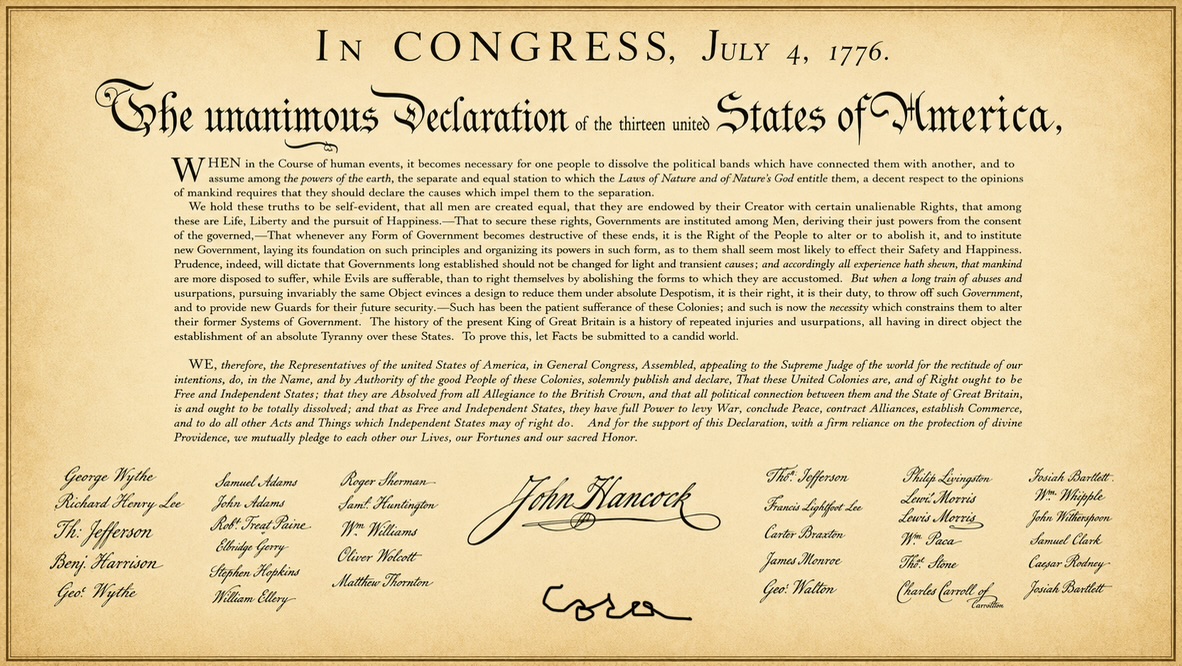
The Declaration says why. The Constitution says how.
That’s it. That’s the sentence to repeat until it’s automatic. Everything below is just filling it in.
Side by side
| Declaration of Independence | Constitution | |
|---|---|---|
| Year | 1776 | 1787 (in effect 1789) |
| What it is | An announcement and an argument | A set of instructions |
| Purpose | To leave Great Britain and explain why | To build a working government |
| Main author | Thomas Jefferson (with a committee, and a lot of edits) | James Madison did the heaviest drafting, but it was hammered out by the whole convention |
| Famous opening | “When in the Course of human events…” | “We the People of the United States…” |
| Signers | 56 | 39 |
| Length | About 1,300 words — a few pages | About 4,500 words, plus 27 amendments |
| Still legally in force? | No — it’s a founding statement, not law | Yes — it is the supreme law of the land |
Three ways to make it stick
1. The breakup letter vs. the owner’s manual
A breakup letter explains a decision that’s already been made: here’s what you did, here’s why I’m leaving. That’s the Declaration. It lists grievances against King George III — twenty-seven of them — and it doesn’t propose a new government at all. It’s the exit.
An owner’s manual doesn’t argue. It tells you which button does what. That’s the Constitution: three branches, two houses of Congress, a president elected this way, judges appointed that way, amendments made by this process. No poetry, mostly procedure.
2. The eleven-year gap is the whole story
Kids often assume the two documents were written back to back. They weren’t, and the gap is the most interesting part.
After 1776 the states did try a first government — the Articles of Confederation. It was deliberately weak, because the whole point of the war had been getting out from under a strong central power. It was so weak that Congress couldn’t raise taxes, couldn’t pay the army, and couldn’t settle fights between states.
So the Constitution isn’t attempt number one. It’s the rewrite. For a kid who has ever had to redo a project because the first version fell apart, that lands immediately.
3. Give each document a job title
- Declaration = the reason
- Articles of Confederation = the rough draft
- Constitution = the rules
- Bill of Rights = the promises (the first ten amendments, added in 1791 because several states refused to ratify without them)
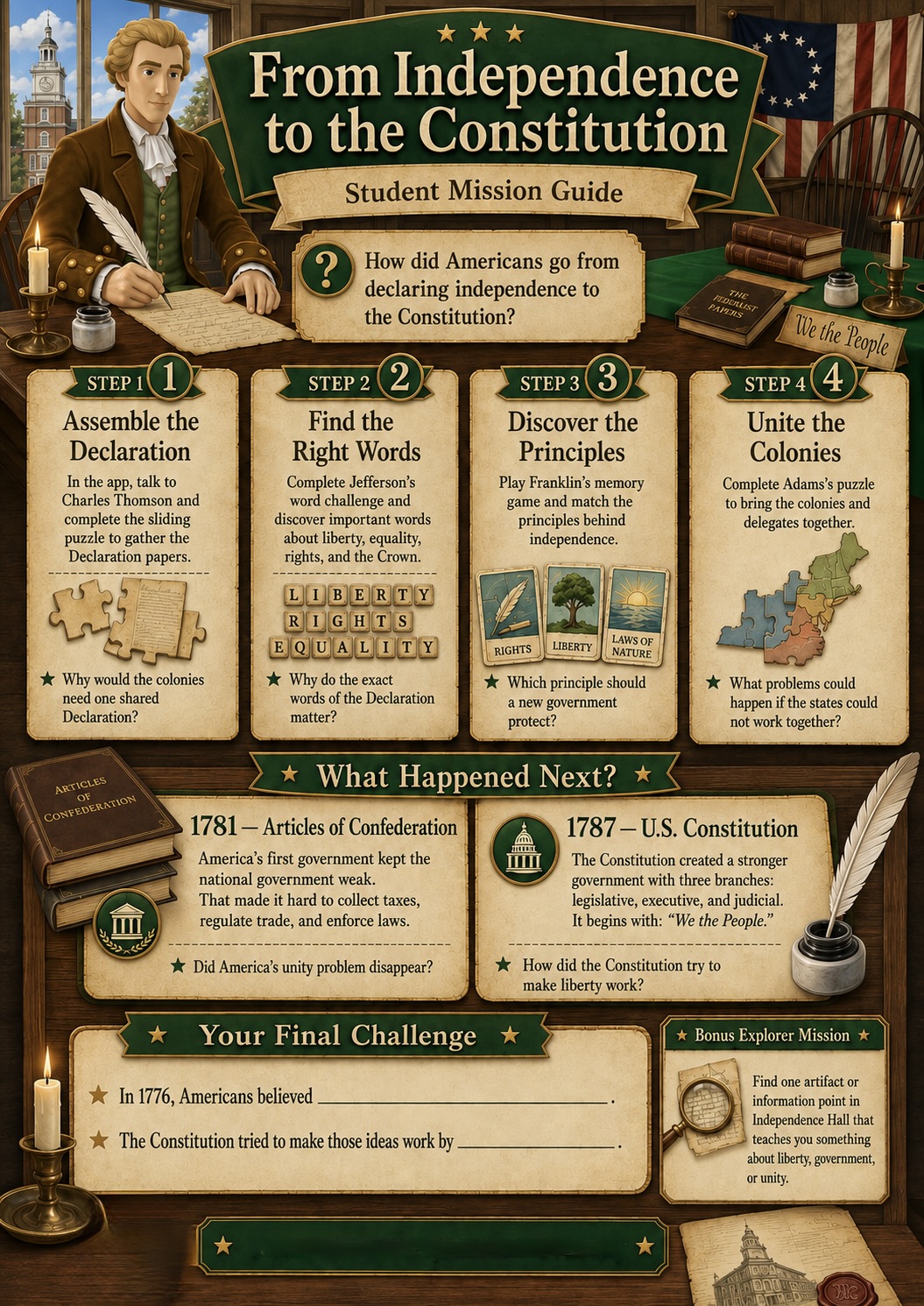
Four cards, four job titles. Shuffle them and have your kid put them back in order. That’s a five-minute review that works for years.
Questions kids actually ask
“Did the same people write both?”
Some. Benjamin Franklin signed both. So did Roger Sherman, George Read, Robert Morris, George Clymer, and James Wilson — six men in all. But Jefferson was in France during the Constitutional Convention, and John Adams was in London. The two most famous names on the Declaration weren’t in the room in 1787.
“Where does ‘all men are created equal’ come from?”
The Declaration. It isn’t in the Constitution.
“Then why do people argue about what the Constitution means if it’s just rules?”
Because rules written in 1787 have to be applied to a world nobody in 1787 could picture. That’s the honest answer, and it’s the beginning of understanding what courts do.
“Can it be changed?”
Yes — twenty-seven times so far. The Constitution contains the instructions for changing itself, which is one of the genuinely remarkable things about it.
Making it a Constitution Day lesson (September 17)
Constitution Day falls on September 17 — the anniversary of the 1787 signing. Federal law requires schools receiving federal funds to hold an educational program that day, so if you’re in a co-op or working with a classroom, this is a ready-made hook.
A 30–45 minute version that needs no prep:
- Two columns on a whiteboard — Why and How. Read a short passage from each document aloud. Kids sort the phrases into the right column.
- Write a household constitution. Who makes the rules? How does someone change one? What happens in a disagreement? The arguments that break out are the Constitutional Convention in miniature.
- The Great Compromise, acted out. Two “big states” and three “small states.” Should each state get equal votes, or votes by population? Let them fight about it, then reveal that the real answer was both — a Senate and a House.
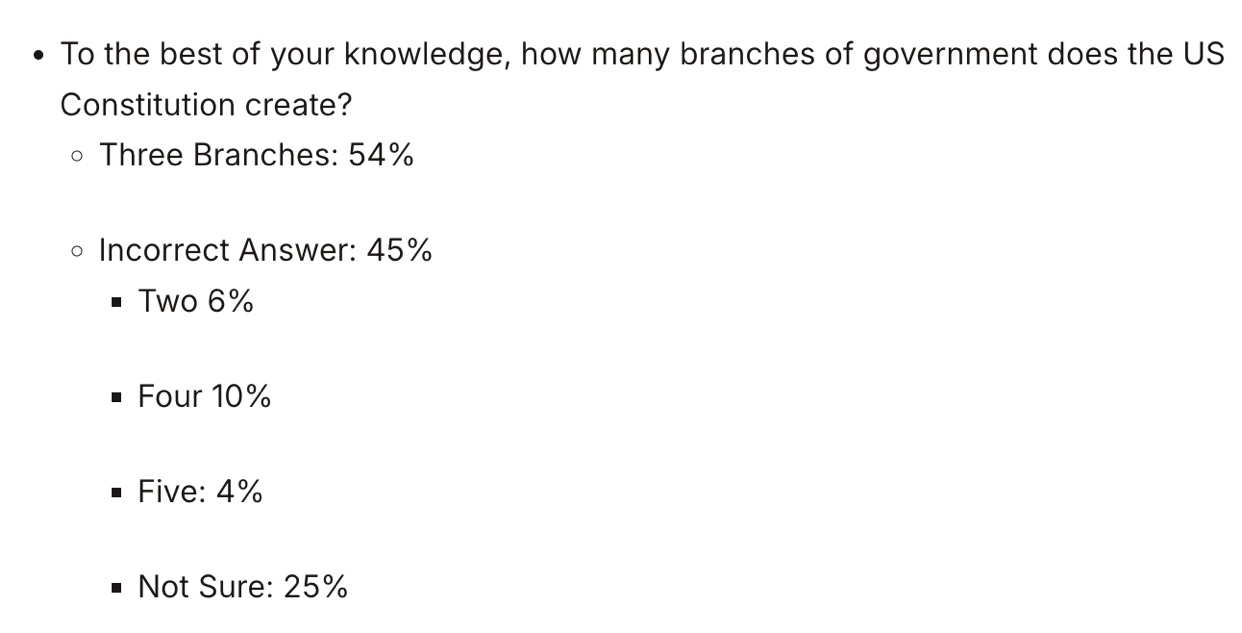
- Three branches sort. Name a job — “decides if a law is fair,” “signs a bill,” “writes a bill” — and have them point to the right branch.
Where the app fits
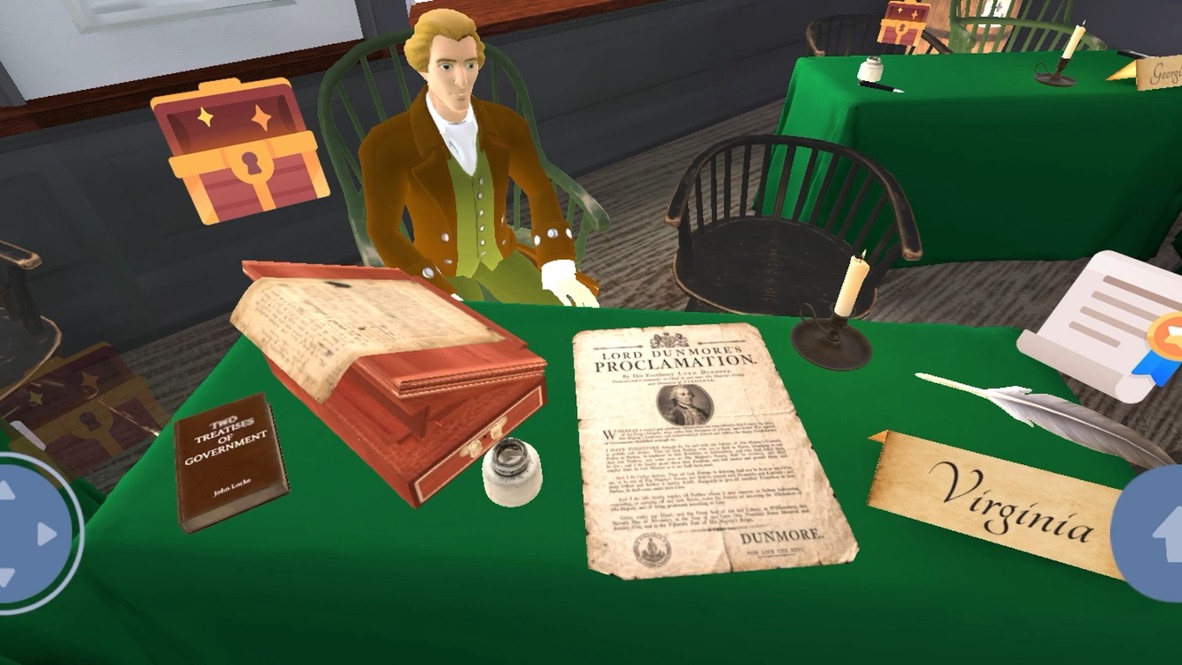
In 1776, kids don’t read about the Declaration — they walk into Independence Hall, work through the wording with Jefferson, and sign it themselves at the desk. Parents keep telling us the same thing: the signing is the moment it stops being a worksheet.
The app covers the why. Use the day itself for the how — and when a child can tell you, unprompted, which document does which job, you’ve given them something most adults can’t do.
1776 is free to download on iOS and Android, with a one-time $5 unlock for the full experience. immersivehistory.com/1776